White Star Line
Location: Liverpool
Founded: 1845
Founders: John Pilkington, Henry Wilson, Thomas Henry Ismay
Successor: Cunard-White Star Line
Areas: Transatlantic, Australia and New Zealand
Note from author: No AI was used to write this piece.
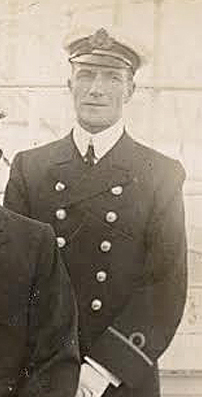
Harold Holehouse, the original Sixth Officer of the RMS Olympic was born on 5-June-1881, in Southsea, Hampshire, England. His parents were Jesse Holehouse, a tobaccoist, and the former Emily Buzza. He also had one older brother, William George Holehouse (born c. 1880). Not much is known about his early life but the 1891 UK Census shows him living with his brother and parents at 61 Castle Road in Southsea. Both he and his brother are listed with the occupation of “scholar”.
It is not known exactly how old he was when he first went to sea but it is known that he did not take the most traditional path to becoming a deck officer with the White Star Line, as under the apprenticeship information section of his White Star Line service records, it says he served as an “AB (Able Seaman) and Bosun for various employers”. One of those employers was the Nelson Line, a small shipping line that specialized in transporting refrigerated meat.
He held an Extra Master’s Certificate and joined the White Star Line on 20-August-1910 as Fourth Officer of the SS Cymric. However, he only held that position for four days, so it is quite likely he never actually sailed with the Cymric during that time. He transferred to the SS Afric in the same role on 24-August-1910, and held that role until 23-May-1911, when he was transferred to the RMS Olympic for its maiden voyage. At the time, the Olympic was the largest ship in the world and while he was the most junior of its deck officers, it was for sure an honour to receive such an assignment. When he signed on to the Olympic, he had moved, as he gave his address as 61 Edmund Road, still in Southsea.
In the famous “Nine-Officer Photo”, which shows the deck officers of the Olympic posing for a picture in Belfast, Holehouse is standing on the far right. As that photo is frequently misidentified as being a photo of the RMS Titanic officers, Holehouse is frequently misidentified as Titanic’s Fifth Officer Harold Godfrey Lowe. His first few months on the Olympic were uneventful until 20-September-1911, when the Olympic collided with the HMS Hawke. Its hull was severely damaged in what became known as the “Hawke Incident”. As a result of the incident, the Olympic was pulled out of service for repairs, which delayed the maiden voyage of its younger sister Titanic.
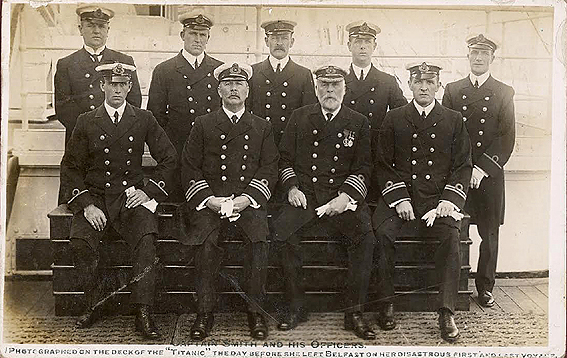
In the famous “Nine-Officer Photo”, which shows the deck officers of the Olympic posing for a picture in Belfast, Holehouse is standing on the far right.
Not only was the Olympic pulled out of service due to the incident, but an investigation also ensued and Holehouse, along with all of the other Olympic deck officers at the time, testified in the inquiry. During his testimony, he noted that on the day of the collision, he made entries in the ship’s rough deck log that he noticed the Hawke was “overhauling Olympic rather quickly. She was heading in the same direction as the Olympic, but a little towards her. When she was abeam of the Olympic, the Hawke was on a parallel course. She did not give any whistle and I lost sight of her just before she struck the Olympic.” When asked how fast the Hawke was going, Holehouse noted that she was “not particularly fast for a ship of her class, but as she turned towards the Olympic, her velocity increased”. The order “Hard-a-port” was given before the collision, but there was hardly any time to get the helm over.
While the Olympic was pulled out of service for repairs, Holehouse, who at the time was a Sub-Lieutenant in the Royal Navy Reserve, went on leave for a Navy drill from 18-October-1911 to 23-November-1911. Though at some point during the drill, he was able to give testimony at the aforementioned Hawke inquiry, as the article about his testimony was dated 18-November-1911. Upon returning to the Olympic, he continued in the role as Sixth Officer and was still in that role on the night of 14-April-1912 when Olympic’s younger sister Titanic sent out distress calls when it hit an iceberg and sank on its maiden voyage. It is not known if Holehouse was on the bridge when Olympic first received distress calls from Titanic; however, he certainly worked almost nonstop over the next 24 hours as Olympic raced 500 miles in an unfruitful attempt to come to the aid of its sister ship.
Approximately one month later, on 14-May-1912, Holehouse was bumped up to the position of Fifth Officer on Olympic as its previous Fifth Officer, John Withers, transferred to the Oceanic as Fourth Officer. He continued serving as Fifth Officer of Olympic until 8-October-1912, when he transferred to the SS Ionic as in the company’s Australia service as Third Officer. Despite remaining with the White Star Line service for more than two additional decades, he did not ever serve on the Olympic again. Between then and 28-July-1914,, he served on the following White Star Line vessels: SS Cymric, RMS Oceanic, SS Canopic, and SS Arabic. On 8-August-1914, as a member of the Royal Navy Reserve, Holehouse was mobilised for naval service during World War I.
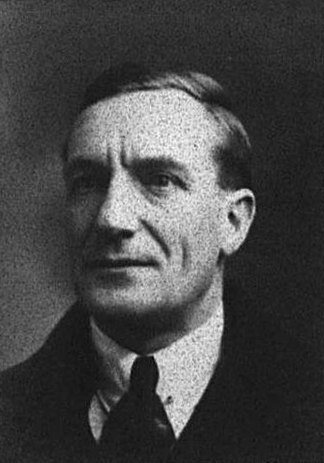
A mug shot of Holehouse for his CR10 record.
During the war, he was engaged in the convoy of trips between England and France. He was promoted to the rank of Lieutenant on 2-August-1915. His first command during the war was the HMS Star, which he was relieved from on 18-October-1917 on account of sickness. Once he was better, he was appointed to command of HMS Lively on 9-May-1918. While in command of Lively in October of 1918 as his ship was returning across the channel, he jumped from his ship to rescue a drowning soldier whose ship had been torpedoed. For these actions, he received the Bronze Medal of the Royal Humane Society, and was presented to King George V. He was demobilised on 21-January-1919, and returned to the White Star Line on 25-February-1919.
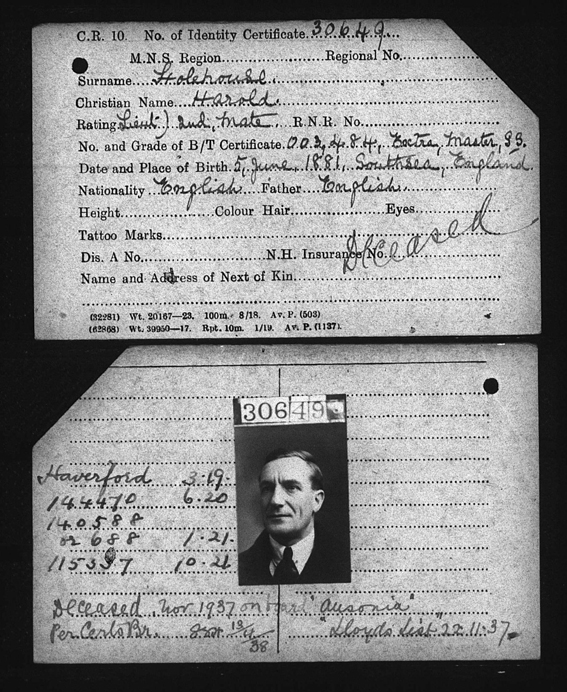
Holehouse's CR10 record.
Upon returning to the White Star Line, he received his first Senior Officer assignment on 04-March-1919, as Second Officer of the SS Haverford. Over the next seven years, with a couple of RNR drill leaves mixed in, he served as either Second Officer or First Officer on the following ships: SS Ypiranga, SS Mobile, SS Vedic, SS Ionic, SS Canopic, SS Ceramic, SS Gallic, RMS Cedric, and SS Corinthic. During one of the drill leaves, he was promoted to the rank of Lieutenant-Commander in the Royal Navy Reserve on 02-August-1923.
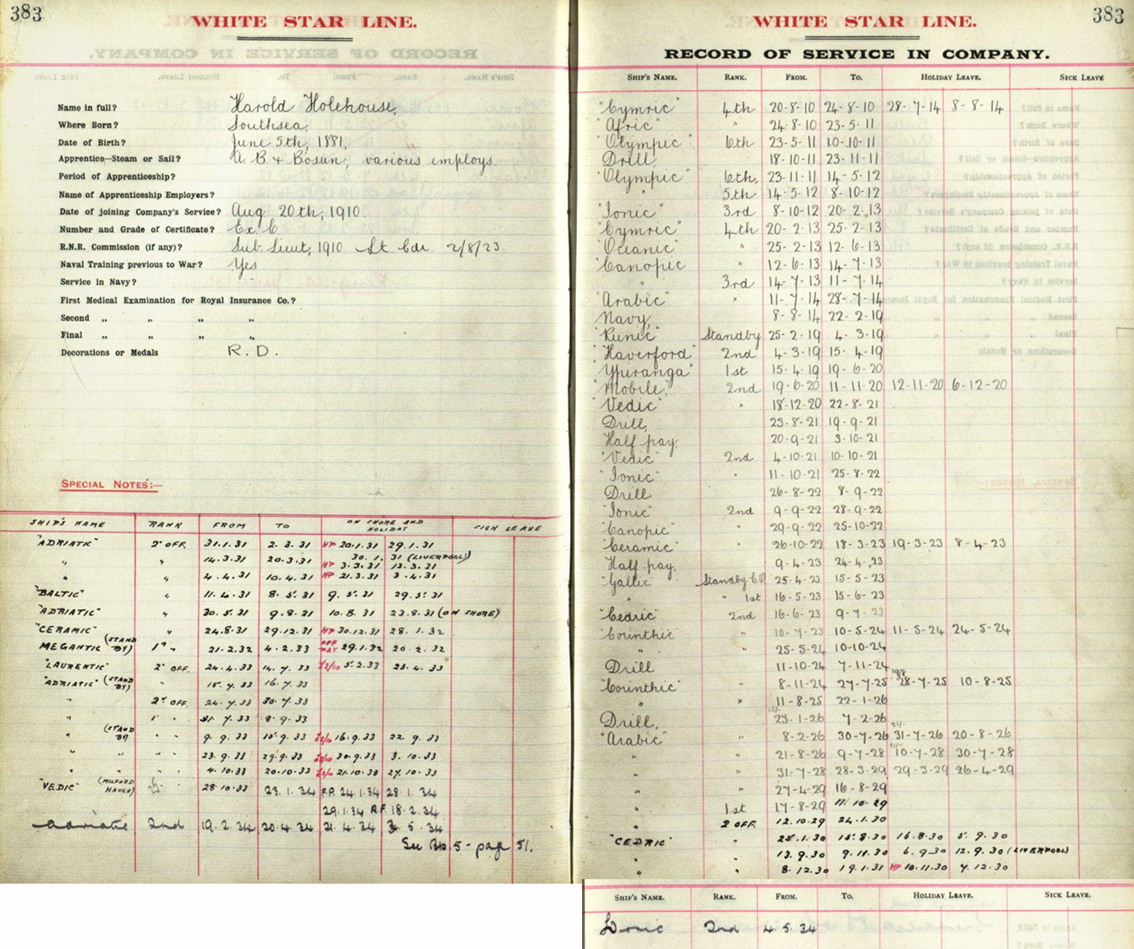
The White Star Line record for Harold Holehouse. (Click to enlarge)
On 8-February-1926, after returning from an RNR drill, Holehouse transferred to the new SS Arabic, a different ship than the Arabic he had served on for two weeks in July 1914 right prior to his World War I mobilisation. Approximately four months into that stint, on 05-June-1926, he was placed on the Royal Navy Reserve retired list. The original Arabic was sunk by a German submarine in 1915, and the new Arabic previously belonged to German shipping company Norddeutscher Lloyd under the name SS Berlin before being awarded to the White Star Line as part of Germany’s war reparations to Britain. Holehouse would serve on the new Arabic until 24-January-1930, a period of almost four years, making it his longest tenure on one ship during his service with the White Star Line.
On 25-January, 1930, Holehouse transferred to the RMS Cedric, which he served on for one year before transferring to the RMS Adriatic from 31-January-1931 to 10-April-1931. Between then and May 1934, when the White Star Line merged with its chief rival Cunard, in addition to the Adriatic, he served on the following ships: RMS Baltic, SS Ceramic, SS Megantic (standby), MV Laurentic, SS Vedic, and the SS Doric. His final assignment prior to the merger was Second Officer on the Doric. His Royal Navy Reserve records show that after the Cunard-White Star Line merger, he transferred to the RMS Aurania (1924) as Junior First Officer in June 1936, before transferring again to the RMS Ausonia (1921), Aurania’s sister ship, in January 1937. The Ausonia would be the final ship he would serve on during his career at sea.
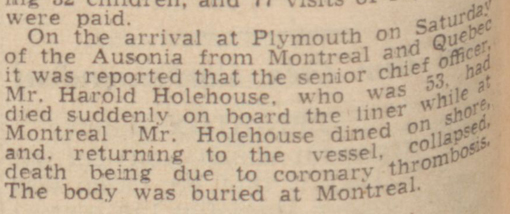
Western Morning News 22-Nov-193.
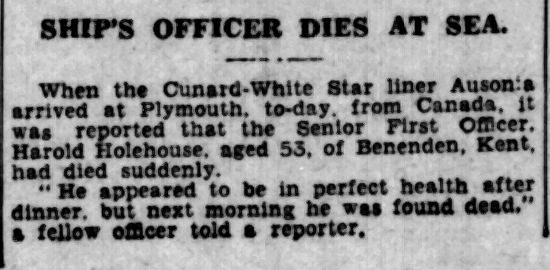
Halifax Evening Courier; 20-Nov-1937,
On 11-November, 1937, while serving as Senior First Officer of Ausonia, Harold Holehouse passed away unexpectedly after a heart attack while the ship was in port at Montreal, Canada. An unnamed fellow officer told a reporter that “he appeared to be in perfect health after dinner (on shore), but next morning he was found dead”. His obituary notes that at the time of his death, he was a bachelor and was still living on Edmund Road in Southsea, with his 80-year old mother, and that he and his mother were “devoted to each other” ever since his father had passed away eight years earlier. His obituary also mentions that he served on the RMS Homeric when it had a slight collision with a French vessel, and the RMS Mauretania as it was about to be scrapped, but his service in those ships are not mentioned specifically in his White Star Line or RNR records.
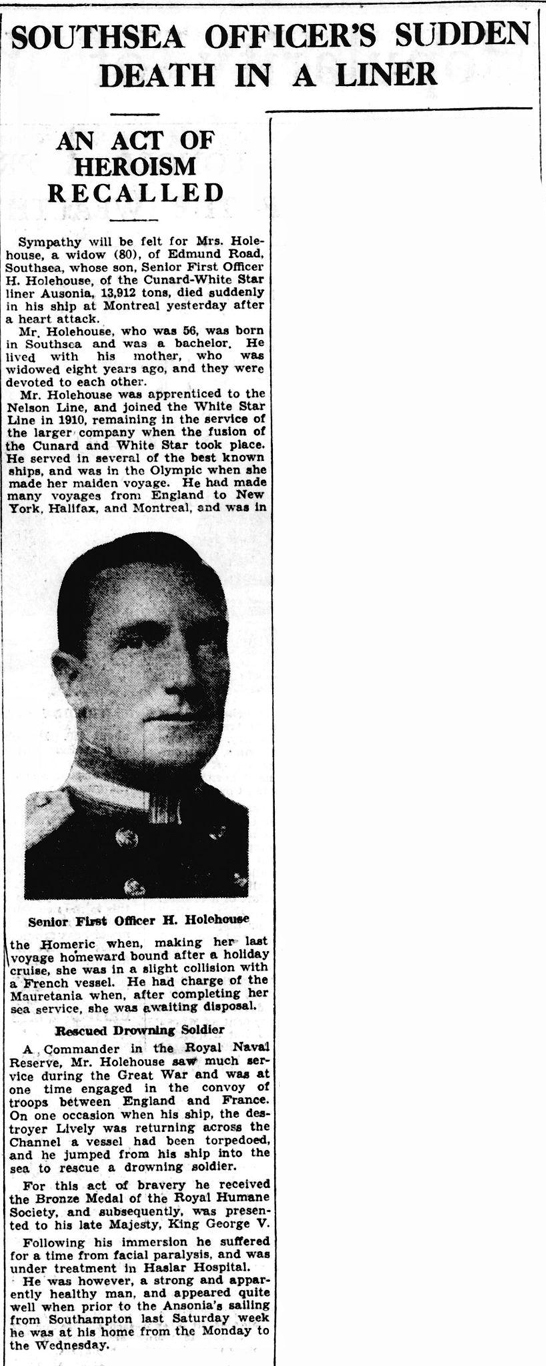
Portsmouth Evening News 12-Nov-1937.,
He was buried in the Sailor’s Plot at Mount Royal Cemetery in Montreal. Interestingly, he was not the only one of the original Olympic deck officers to be buried in that cemetery, as Henry Osborne Cater, the original Third Officer of the Olympic, was buried there after dying suddenly in 1928 while serving as Chief Officer of the SS Megantic. Holehouse’s probate records list his brother, William, as the beneficiary of his effects, valued at £1247.
- 1891 United Kingdom census (via FindMyPast.co.uk).
- White Star Line record of company service (via FindMyPast.co.uk).
- https://www.titanicofficers.com/article_01.html (Olympic crew sign-on sheet)
- Irish News and Belfast Morning News, 18-Nov-1911
- https://www.dreadnoughtproject.org/tfs/index.php/Harold_Holehouse
- Service Records ADM-340), The National Archives.
- Portsmouth Evening News, 12-Nov-1937
- Halifax Evening Courier; 20-Nov-1937
- Western Morning News; 22-Nov-1937
If this website has been of some help, please consider supporting it with a coffee
to ensure it can continue. It can be anonymous. Anything helps!: