White Star Line
Location: Liverpool
Founded: 1845
Founders: John Pilkington, Henry Wilson, Thomas Henry Ismay
Successor: Cunard-White Star Line
Areas: Transatlantic, Australia and New Zealand

Captain Beadnell in 1903, when he took command of
the SS Coptic for the first time.
Captain Frank Ernest Beadnell, who served as Master of many White Star Line ships, was born 4 June 1871, in Alderton, Suffolk, England. His father, Thomas Fawcett Beadnell, was a master miller, and his mother was the former Caroline Blormfield. He had four older sisters (Rose, Alice, Marion “Minnie”, and Florence), as well as one older brother (Thomas Fawcett Beadnell Jr.). After Frank’s birth, one more sibling (a younger brother named Percy), would follow in 1873. Between the 1871 and 1881 censuses, it appears that the elder Thomas Beadnell passed away and Caroline remarried (unknown to whom), as the latter census shows her living in the West Ham neighborhood of East London as an “engineer’s wife” and like other children of that era, Frank is listed in the census as a “scholar.”
Young Frank first went to sea in 1885, as an apprentice in the full-rigged ship Titania (897 tons), under the command of Captain James L. Dunn. The ship was owned by the Hudson's Bay Company, and at the time, its primary focus was carrying cargo of steel rails to support the western extension of the Canadian Pacific Railroad, trading between London, Victoria, and Vancouver Island. It was during this apprenticeship that he was nearly shipwrecked off the coast of Seattle. Around 1891, at about age 20, he left the Titania as Second Mate to sign on aboard the celebrated clipper Cutty Sark, then owned by John Willis and engaged in the England–Australia wool trade, before leaving her to join the Dharwar. He briefly served as Third Officer aboard the Shire Line's Glamorganshire in the China and Japan trade, making only one voyage before leaving to study for his master's certificate, which he passed. He then joined Shaw, Savill and Albion's Tanui as Third Officer for one voyage, on the company's routes between London and New Zealand.

A model of Captain Beadnell’s first ship, the Titania.
He would not remain with Shaw, Savill, and Albion for long, as in October 1895, he joined the White Star Line as Fourth Officer of the original RMS Majestic, then serving as a government-subsidized armed merchant cruiser, after a call went out for junior officers belonging to the Royal Naval Reserve. By early 1896 he transferred to the SS Coptic. He was serving as a senior officer on that ship in 13 July 1898, when the ship brought the news to the Hawaiian islands that they had been annexed by the United States. As the Coptic prepared to leave San Francisco for Honolulu, Japan, and China, her officers bought up every available American flag and newspaper they could find, and the ship arrived off the islands dressed and flying a signal announcing the annexation. The U.S. destroyer Nero, then escorting two monitors out to reinforce Admiral Dewey at Manila, had been awaiting the Coptic's arrival for news and mail. Word of the ship's news spread quickly ashore, and by the time the Coptic docked at Honolulu, a crowd had gathered to meet her. Like many other White Star Line officers who served in the company's Pacific service, Captain Beadnell lived for a time in the United States. It was in San Francisco that he met his future wife, the former Katherine "Kate" May Burke, an Irish-born woman three years his senior, and the two were married in San Jose, California, in 1900 with the 1900 United States Census showing the couple residing together in San Francisco.
In April 1905, Captain Beadnell left the Coptic after serving on the ship for almost nine straight years, transferring to command the SS Armenian and RMS Gaelic, before his first stint commanding the SS Cymric from July to October 1905. He also commanded the SS Persic around that time before a shore appointment as the White Star Line’s first Marine Superintendent in Genoa, Italy as the company was expanding its reach in the Mediterranean. After helping set up that service, he returned to the sea as Master of the SS Romanic, running between Italy and Boston, Massachusetts in the United States. While in command of the Romanic, on 12 July 1907, the ship collided with the 66-ton schooner Natalie B. Nickerson, resulting in the loss of three out of eighteen of the Nickerson’s crew. According to a newspaper article, Captain Beadnell said that his ship was sailing slowly through heavy fog when it first encountered the Nickerson’s light but there was not sufficient time for the Romanic to veer away and avoid a collision. Captain Beadnell and his crew picked up the survivors and took them to Boston.

Captain Beadnell with Purser Robert Edwards of the SS Cymric in 1915.
Captain Beadnell would remain in command of the SS Romanic until September 1908, when he transferred to command the SS Laurentic, a role which he would hold for less than two months as between then and January 1916, he rotated in command of many different White Star Line ships, none of which he served on for longer than eight months at a time: SS Laurentic, SS Cufic, SS Megantic, the original RMS Majestic, SS Cymric, RMS Adriatic, RMS Celtic, RMS Cedric, SS Cretic, RMS Olympic, and RMS Baltic. While commanding this Majestic, on 17 October 1913, he rescued the crew of the sinking French schooner Garonne, and received a pair of binoculars from the French president. His White Star Line records list his tenure as the Olympic’s master as lasting from 02 September 1915 to 13 October 1915 with “coastal voyage” being listed in parentheses on those records. However, the records of fellow White Star Line Captain Sir Bertram Fox Hayes show him taking over the Olympic on 18 September 1915. Maritime historian Mark Chirnside notes that the Olympic’s log shows Hayes superseding Beadnell so it is quite possible his tenure on the Olympic was only on shore or that the “coastal voyage” he commanded it for was merely a repositioning voyage to prepare for war mobilisation.
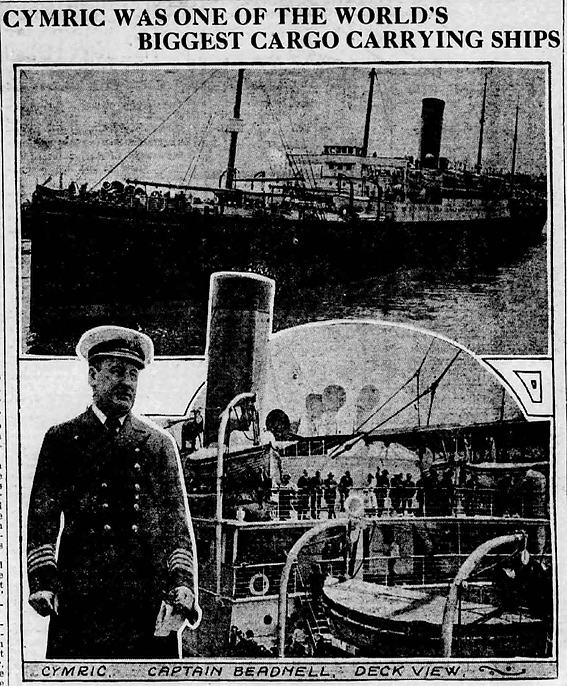
Captain Beadmelll aboard the Cymric in 1916. (Waco Times-Herald, 14 May 1916)
On 31 July 1915, while commanding the SS Cymric, Captain Beadnell once again played a role in rescuing the crew of a foundering schooner, the Gypsum Queen, which was carrying timber from Halifax, Nova Scotia, Canada to Preston, England. He was “highly commended by the Cymric’s passengers who lined the ship’s rails and witnessed the rescue.” Only three months later, on 16-October-1915, he took command of the RMS Baltic, replacing Captain Joseph Barlow Ranson, who transferred to the RMS Adriatic in the stead of the aforementioned Captain Sir Bertram Fox Hayes, who transferred to the RMS Olympic. Newspaper reports regarding Beadnell’s appointment to the Baltic note that he “had a very quick turn round this voyage, as he only arrived at Liverpool on Tuesday in the Cymric, and left again the following day in the Baltic” contradicting records that show his Olympic tenure lasting till that date.

Undated photo of Captain Beadnell.
After two months commanding the Baltic, Beadnell returned to the Cymric as commander on 1 January 1916 for the final time, as four months later, on 09 May 1916, just past noon, the Cymric itself was torpedoed by a German submarine. All but five of its crew were rescued, with four of the five (two engineers, a greaser, and a fireman) dying instantly as the torpedo struck the ship’s engine room on the port side, and the fifth victim, the Chief Steward, drowned while trying to enter a lifeboat. Five boats were lowered successfully and as it became clear that the Cymric was not going to sink immediately, Captain Beadnell and the wireless operator returned to the ship to send out an S.O.S. call. A British naval vessel arrived at 9:10pm, standing by in the area until the Cymric sank in the wee hours of morning at 3:15am the next day. There were no international repercussions that occurred as a result of the sinking, as there were no passengers on board. To this day, the wreck of the Cymric has not been located.

A colour image of Captain Beadnell aboard the Adriatic,in 1926 (still from BFI "Liverpool docks and the Mersey" 1926, courtesy of Conner Nelson).
Only one month after the sinking of the Cymric, Captain Beadnell returned to the command of the SS Megantic on 16 June 1916, and his tenure on the Megantic would be his longest tenure on one ship since his time on the Coptic, as he remained in command of the ship until 06 May 1921, a period of almost five years. On 28 February 1919, three days after the Megantic sailed from Liverpool, her wireless operator summoned Captain Beadnell to the wireless room and had him listen in mid-Atlantic to a phonograph record being played aboard the American Line steamship Kroonland, then a United States Army transport, some four miles away, a feat accomplished despite the Megantic carrying no wireless telephone apparatus of her own. "I could not believe it at first," Beadnell later told the Liverpool Evening Express, "but I could distinctly hear the human voice as it had been reproduced on the phonograph." Though he could make out the words "This is the U.S. Army transport Kroonland," he described the voice as sounding "miles and miles away," giving the experience "a feeling that it was sort of ghostlike." Reflecting on the technology's potential, he remarked, "I don't know what progress has been made with the wireless telephone, but such a device would be of wonderful value on ocean ships, especially in thick weather, as it would permit ships to easily exchange their whereabouts or position to other craft." That same crossing produced another small piece of Megantic lore: a daughter, born at sea to Mr. and Mrs. M.S. Bree of New York a few days after the ship sailed from Liverpool for Portland, was christened Margaret Beadnell Bree in honor of the ship's commander, and was reported upon the Megantic's return to Liverpool as the youngest "leading lady" to arrive at that port in years.
Later that same tenure, on a voyage from Portland to Liverpool via Halifax that departed on 6 December 1919 and arrived on 18 December 1919, the Megantic, carrying some 2,000 passengers, encountered an exceptionally violent storm so severe that few passengers left their berths for two or three days running.. In recognition of Beadnell's handling of the ship through the storm, the saloon passengers held a meeting aboard ship on the return crossing, presided over by octogenarian passenger J.E. Hargreaves, himself a veteran of over a hundred Atlantic crossings. On a motion moved by Sir John Prestige, the passengers adopted a resolution congratulating "Commander F.E. Beadnell upon the capable handling of his ship through the exceptionally violent storm," thanking him for "the careful and skillful seamanship displayed by him during a most trying time," and commending the White Star-Dominion Line for employing "such a capable and reliable officer." The passengers further presented Beadnell with a gift inscribed "Presented to Commander F.E. Beadnell by passengers of the Royal Mail steamer Megantic as a token of appreciation," a presentation formally made in a shipboard ceremony reported on 11 February 1920.
From 06 May 1921 until October 1921, he commanded the RMS Celtic, before transferring back to the RMS Baltic until December 1922, when he took command of the RMS Adriatic, a role which he would also hold for nearly five years, until his 1927 retirement. During his tenure on the Adriatic, reporter T.G. Barman of the Liverpool Evening Express interviewed Captain Beadnell about his career as part of his regular column profiling merchant shipping captains. In the profile of Captain Beadnell, Barman noted that regarding how quickly Beadnell rose to command, "there are not many men who have accomplished the arduous climb from the position of Junior Officer to that of Command in nine short years. Indeed, it might almost be said that under present conditions in the merchant marine such a feat would be impossible and could not be duplicated. Promotion such as this would be stretched over about 15 years." Barman also noted that Captain Beadnell was still a big proponent of wireless technology, as he kept a five-valve wireless set in his cabin and spent his time away from the bridge "amusing himself by receiving concerts, and addresses broadcast from either side of the Atlantic."

Captain Beadnell on the bridge of the RMS Adriatic in advance of his 1927 retirement.
In late April 1927, it was reported that Captain Beadnell was going to retire on June 4th of that year, his 56th birthday. While the White Star Line's retirement age was 60, he elected to retire early in order to "give younger men a chance of promotion." When the Adriatic sailed for Liverpool on his last voyage as her master, Captain Beadnell received well-wishers in his quarters, among them Paddy McDonald, described as "the man who coals the ships," and Frederick Toppin, vice president of the International Merchant Marine Company, White Star's parent, along with other officials and former passengers who had become close friends over his twenty-four years as a White Star commander. Beadnell later admitted that saying goodbye to these friends, most of whom were in America, was the hardest blow of his maritime career, though he did not regret his decision to leave the sea. "My connections are all over here," he said. "Even my wife I met in San Francisco. We were married in San Jose, California, in 1900. But I feel that I should make way for others and not stop promotion. I do not wish to stand in the way of other deserving men. Promotion in all good companies is slow. So, at the age of 56 — I am just a boy, you know — I am stepping down."
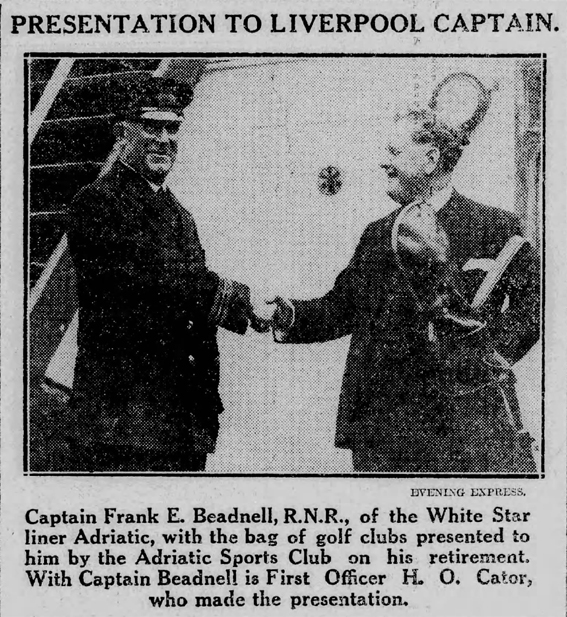
Captain Beadnell (right) is presented a retirement present by "First Officer H.O. Cator" [sic] (Liverpool Evening Express 28 April 1927).
In an interview with the Wolverhampton Express and Star, Beadnell recalled his early days with the company, noting that he "had only been eight years in the White Star service when I obtained a command at the age of 33," which made him the youngest commander ever appointed by the Line. At the time of his retirement, he was "one of the few remaining ship masters in the Atlantic trade whose active service began in the famous clipper ships of England. "I think I owe it to my wife and myself that we should have at least a few years together before departing this life," Beadnell said. "A seafarer sees but little of his home when in active service. I have built a little house on the Isle of Man with a good view of the ocean. I am going there to watch the ships."

Photo Gallery (of his house on the Isle of Man) .

Photo Gallery (of his house on the Isle of Man) .
Captain and Mrs. Beadnell had indeed already built this house on the Isle of Man. It was known as May Bank and it was in the village of Baldrine, near Garwick Beach. It still exists today as a private home and was on the market in the last few years. The Beadnells’ retirement was not all peace and quiet, as on 22 January 1938, Mrs. Beadnell’s purse was snatched from her in an attack at the front gate of her home. Newspaper reports note that the attack “upset Captain Beadnell considerably, as he is not in good health.” Just over a year later, on 04 April 1939, as World War II commenced, his Royal Navy Reserve records note that he was suffering from pernicious anaemia, but that he is “willing to offer his services to the country.”
In 1946, as their health continued to decline in old age, Mrs. Beadnell placed several want ads in the Isle of Man Times seeking “domestic help.” On 23 February 1954, Captain Beadnell died at the age of 82 and was buried at the Borough Cemetery three days later in a private ceremony. Less than two months later, Mrs. Kate May Beadnell died on 17 April 1954; she too was buried three days later in the same cemetery. As they did not have any children, his personal estate (valued at £2,000) was bequeathed to his sister Minnie and her children, and his household furniture was auctioned off to the public.
Websites
- Encyclopedia Titanica thread (Picture from 1903: Capt Beadnell: https://www.encyclopedia-titanica.org/community/threads/picture-from-1903-capt-beadnell.25491/).
- White Star Line service records of Frank Ernest Beadnell, John Henry Rinder, and Francis Henry Armstrong (via FindMyPast.co.uk).
- Royal Navy Reserve records, ADM-240 and ADM-340 for Frank Ernest Beandell (via nationalarchives.gov.uk).
- 1871 Census of England & Wales (via FindMyPast.co.uk).
- 1881 Census of England & Wales (via FindMyPast.co.uk).
- 1900 United States Census (via FindMyPast.co.uk).
- Hatfield v. Guay, 87 F.2d 358 (1st Cir. 1937) (via https://law.justia.com/cases/federal/appellate-courts/F2/87/358/1545774/).
- Wanted on Voyage Ocean Liner Monographs by Peter Kohler: White Star’s Big Ship SS Cymric (via https://wantedonthevoyage.blogspot.com/2023/12/white-stars-big-ship-ss-cymric.html).
- Wikipedia article on SS Cymric (https://en.wikipedia.org/wiki/SS_Cymric).
Newspaper articles (most via FindMyPast.co.uk)
- Excerpt of The Pacific Commercial Advertiser (14 July 1898) via (https://www.studocu.com/en-us/document/myers-park-high-school/us-history/801-us-in-hawaii/115254484).
- San Francisco Call (04 January 1903).
- Ottawa Free Press (13 Jul 1907).
- Liverpool Journal of Commerce (07 August 1915).
- Liverpool Journal of Commerce (16 October 1915).
- Yorkshire Post and Leeds Intelligencer (10 May 1916).
- Nottingham Evening Express (11 May 1916).
- Liverpool Evening Express (20 December 1924).
- New York Times (16 April 1927).
- New York Daily News (17 April 1927).
- Liverpool Journal of Commerce (25 April 1927).
- Wolverhampton Express and Star (25 April 1927).
- Isle of Man Times (22 January 1938).
- Isle of Man Times (27 February 1954).
- Isle of Man Times (24 April 1954).
- Isle of Man Times (22 February 1957).
- Isle of Man Times (18 April 1957).
Other Sources
- Reddit thread on Mark Chirnside’s list of RMS Olympic captains
(https://www.reddit.com/r/titanic/comments/1iza8f9/there_are_two_different_versions_of_list_of_rms/#lightbox).
- May Bank real estate listing (https://media.onthemarket.com/properties/2466043/doc_0_3.pdf
If this website has been of some help, please consider supporting it with a coffee
to ensure it can continue. It can be anonymous. Anything helps!: