White Star Line
Location: Liverpool
Founded: 1845
Founders: John Pilkington, Henry Wilson, Thomas Henry Ismay
Successor: Cunard-White Star Line
Areas: Transatlantic, Australia and New Zealand
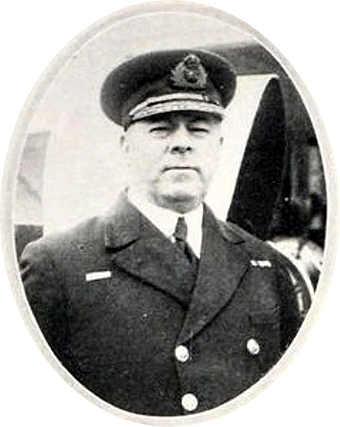
Captain George R. Metcalfe, in an undated image.
Captain George Robert Metcalfe, who served as Master of several of the largest White Star Line ships, as well as commodore of the company’s fleet, was born 28 September 1870 in Helmsley, Yorkshire, England, the youngest of seven children born to William Metcalfe and his wife Elizabeth. The family’s residence was known as Potter Gate, and he had two older sisters (Elizabeth Ann and Sarah Frances) as well as four older brothers (Thomas, William, Charles, and Joseph).[1.] His father was a farmer, and growing up, the family was, in the captain’s own words, “not what you would call rich.”[2.]
Not long before Captain Metcalfe was born, Helmsley was considered a “sleepy, rather backward country town,” but that changed about a year before his birth when Charles Norris Gray was appointed vicar of the town.[3.] Determined to modernise the town, improve the living conditions of its residents, and increase access to education, Gray set about transforming the community.[4.] As a boy, Captain Metcalfe had use of the vicar’s library, where he read the stories of great seafarers such as Sir Francis Drake, Sir Walter Raleigh, Christopher Columbus, and Horatio Nelson.[5.] He came to revere those men and decided that one day, he too, would go to sea.[6.] In 1886, at the age of fourteen, with his family’s blessing, Captain Metcalfe left home with only a few shillings in his pocket and all of his belongings in a bag slung over his back to begin his long career at sea.[7.] For his first twenty-two months at sea, he served on the SS Pelican, belonging to Seater, White, & Co of Leith.[8.] He then joined the shipping firm of Messrs. J. Davies and Co., of Swansea, serving as an apprentice in their barques (including the Emily A. Davies) that sailed from the Bristol Channel to the west coast of South America via Cape Horn, weathering fierce storms along the way.[9.] Next, he joined the barque Mercia, owned by Messrs. Pantland Hick & Co., of Scarborough, where he continued his apprenticeship, before joining the barque Alliance, owned by Messrs. R. & J. Evans & Co., of Liverpool, in which he completed his apprenticeship.[10.]
He continued in the Alliance as Second Mate, then First Mate, before transitioning from sail to steam, joining the steamer Moelydon, belonging to the Gwynedd Shipping Company of Caernarvonshire. In the Moelydon, he traded not only to South America, but also to Australia via the Indian Ocean.[11.] On 26 October 1895, Captain Metcalfe obtained his Master’s certificate.[12.] Just over a year later, after three years and eleven months with the Gwynedd Shipping Company and ten total years at sea, Captain Metcalfe joined the service of the White Star Line in December 1896.[13.]
Captain Metcalfe’s first assignment with the White Star Line was as Fourth Officer on the original SS Georgic, a ship primarily designed for carrying livestock between the UK and Australia.[14.] At the time, it was the largest cargo steamer afloat.[15.] By 1899, Metcalfe was serving as Second Officer aboard the SS Germanic in the company’s Atlantic service, a role he held until his promotion to First Officer on the same vessel in April 1901.[16.] In January 1902, he transferred as First Officer to the SS Gothic in the company’s New Zealand service and in May 1902, he returned to the North Atlantic as First Officer of the RMS Celtic, then the world’s largest ship.[17.] For Captain Metcalfe, late 1902 also included a brief stint on the original RMS Majestic as First Officer, then commanded by future Titanic Captain Edward J. Smith, with future Titanic Second Officer Charles H. Lightoller on board as Third Officer.[18.]
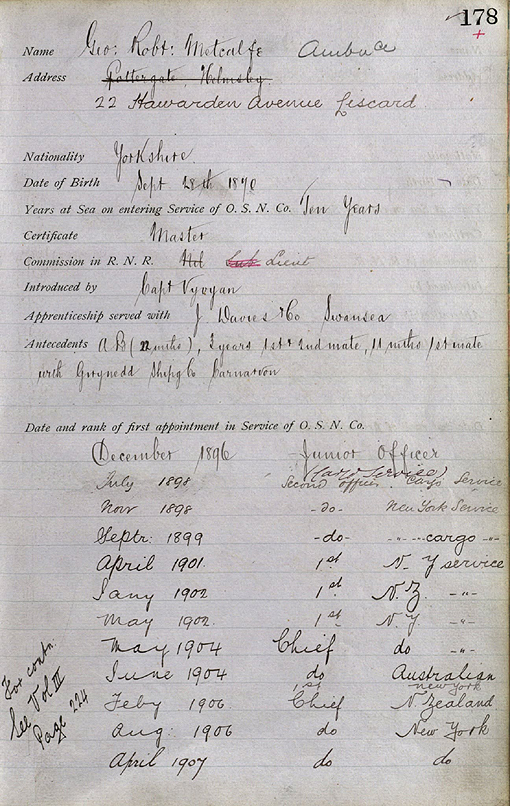
Metcalfe's original White Star record.
In January 1903, he moved briefly to the SS Cymric before joining the RMS Oceanic in March, which he served on until May 1904, when he received his first Chief Officer posting aboard the SS Arabic, in the company’s Boston service, followed shortly by an assignment in June to the SS Medic in the Australian trade.[19.] Early 1905 brought key changes to both his personal and professional life. During his transition off the Medic, he married the former Elizabeth Williams at the church of Our Lady and St. Nicholas, facing the River Mersey close to the Pier Head.[20.] It is the parish church of Liverpool but is also known as the “Sailor’s Church.”[21.] Following his marriage, he returned to the Celtic as First Officer in March 1905.[22.]
In November 1905, he transferred as First Officer aboard the RMS Baltic, also under the command of Captain Smith, which had by then surpassed the Celtic as the world’s largest vessel.[23.] He fleeted back up to Chief Officer on the Gothic in February 1906, followed by a posting on the Arabic in August 1906, before returning to the Baltic as Chief Officer in April 1907.[24.] On 08 October 1907, Mrs. Metcalfe gave birth to the couple’s first child, a son named William George.[25.] In March 1908, Captain Metcalfe achieved his first command as Master of the SS Georgic, the same ship in which he began his White Star Line career twelve years earlier.[26.] After a brief return to the Baltic as Chief Officer from June to October 1908, he received command of the SS Cufic in February 1909, from which he would never look back.[27.]
Captain Metcalfe remained in command of the Cufic until August 1909, when he transferred back to the Georgic for three months.[28.] Subsequent to his time on the Georgic, he took command of the SS Runic, also in the company’s Australian service.[29.] During his tenure on the Runic, his wife Elizabeth gave birth to a daughter, also named Elizabeth, on 14 October 1910.[30.] Despite commanding the Runic for just over two years, nothing else newsworthy occurred during that tenure. He left the Runic in January 1912 for his first trans-Atlantic command, the Dominion Line’s SS Cornishman.[31.] Just under two months later, in March 1912, Captain Metcalfe transferred to command the SS Canopic in the White Star Line’s Boston service.[32.]
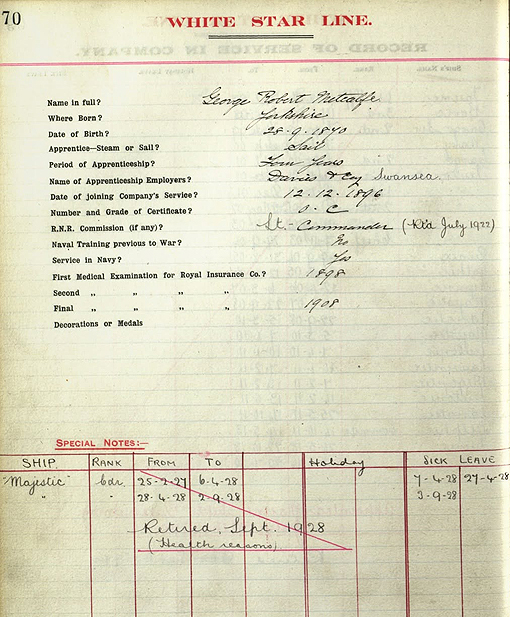
Metcalfe's White Star record.
At the time of the Titanic disaster in April 1912, the Canopic was operating Mediterranean cruises with port calls at Naples and Genoa in Italy, and Ponta Delgada in the Azores.[33.] When the disaster occurred, the Canopic, which had departed Naples the same day (10 April) that Titanic left Southampton, was travelling westbound towards Ponta Delgada, putting it outside the range of Titanic’s distress signals. As such, the RMS Baltic, which had heard Titanic’s calls, relayed the harrowing news to Captain Metcalfe.[34.] To avoid causing excitement, the news of Titanic’s foundering was kept from passengers until they reached Ponta Delgada the following day.[35.] One of the Canopic’s passengers at the time was William Wirth Kimball, a retired U.S. Navy Rear Admiral who was returning home from a winter holiday in the Mediterranean.[36.] A veteran seaman himself, Admiral Kimball offered words of praise regarding Captain Metcalfe’s decision-making, noting that immediately upon learning of the Titanic disaster, he took the Canopic on a southerly course 150 miles below the normal path of steamers to keep the ship at a safe distance from icebergs.[37.] The saloon passengers of Canopic, which arrived in Boston on 24 April 1912, raised $92 for the Titanic relief fund and for its next sailing on 27 April 1912, the number of passengers was limited to the capacity of the ship’s lifeboats.[38.]
Captain Metcalfe remained on the Canopic until 10 January 1914, when he was transferred to the Titanic’s sister ship, the RMS Olympic, as its first Assistant Commander (a.k.a. Staff Captain).[39.] After the Titanic disaster, White Star Line’s rival Cunard introduced the position on their two largest liners, Mauretania and Lusitania, and not long after, White Star did the same for the Olympic, “owing to the increased size of this class of steamers.”[40.] The Assistant Commander did not replace the Commander but assisted him with carrying out certain duties, including but not limited to supervising lifeboat drills.[41.]
Metcalfe’s tenure as Olympic’s Assistant Commander included the Audacious incident that occurred 27 October 1914. When Olympic was on its last eastbound crossing from New York prior to being laid up for its war refit, the British warship HMS Audacious struck a German-laid mine approximately twenty-five miles off the Irish coast.[42.] At the time, Olympic was about ten miles away and responded to the Audacious’s distress call. Upon arrival at the scene, Staff Captain Metcalfe directed the launch of Olympic’s lifeboats, ultimately saving the lives of many Audacious crew members.[43.] It would not be the last time Captain Metcalfe effected a rescue at sea, but a few weeks later, on 17 November 1914, Metcalfe left the Olympic to take command of the SS Megantic.
In early January, less than two months after taking command, the Megantic encountered fierce winds of up to 170 miles per hour while sailing from Liverpool to New York. During the storm, three crew members nearly lost their lives chasing a lifeboat that had broken loose.[44.] Although the ship reached port safely, this storm was not the most notable incident that occurred during Captain Metcalfe’s tenure commanding the Megantic. Two months later, on 22 March 1915, the Megantic came to the aid of a sinking freighter when the Mallory Line steamship Denver, which was traveling westbound from Bremen, Germany, began to take on water and sink due to a leak.[45.] As one of several vessels responding to the Denver’s distress calls, the Megantic deployed a lifeboat commanded by Chief Officer Frederick J. Burd, which successfully rescued the Denver’s captain, his wife, and thirteen crew members. The remaining crew members were picked up by another responding ship, the Atlantic Transport Line freighter Manhattan.[46.] Newspapers noted that due to the heavy seas, the rescue was difficult, but because of “the splendid seamanship of Captain Metcalfe, it was effected without a mishap.”[47.] For his role in rescuing the Denver’s survivors, Captain Metcalfe was presented a gold watch and chain from the Lord Mayor of Liverpool, a silver medal from the Liverpool Shipwreck and Humane Society, and a gold watch from the President of the United States via the United States Consul in Liverpool.[48.] With World War I intensifying around that time, passenger steamers like the Megantic had to maintain a sharp lookout for German U-boats, especially after one sank the Cunard Line’s RMS Lusitania on 07 May 1915 off the southern coast of Ireland. Less than a month later, shortly after leaving Liverpool, U-boats chased the Megantic, prompting Captain Metcalfe to transmit an “S.O.S.” as a precaution.[49.] Fortunately for Captain Metcalfe and the passengers (which included Lusitania survivor Harold M. Daly), the vessel successfully evaded the enemy submarines through sheer speed and precise zig-zag manoeuvring.[50.]
Captain Metcalfe remained in command of the Megantic until 25 June 1916 when, after almost two years on that ship, he returned to one of his previous commands, the Canopic, on 07 August 1916.[51.] Despite a return to the Boston-Mediterranean service, Metcalfe’s days of evading U-boats were not over, as on 08 October 1916, not long after departing the Azores, Captain Metcalfe received word that the British cargo steamer SS West Point had been torpedoed by a U-boat off the coast of Nantucket.[52.] As such, he altered the ship’s course, extinguishing every light at night and adding extra lookouts and stokers per watch, as the ship raced across the Atlantic to successfully evade the U-boat, completing its fastest passage ever from the Azores to Boston.[53.] In February 1917, however, the opposite happened, as the Canopic took thirty days on a voyage that normally takes thirteen after being held eight days at Gibraltar and three at Palermo.[54.] While no submarines were spotted by Captain Metcalfe during that trip, passengers reported that no lights were shown during the entire voyage and that a detour was made from the regular line of travel.”[55.] Also during this tenure on the Canopic, a personal family moment involving Captain Metcalfe and his son was preserved. On 12 November 2023, local Chorlton historian Tony Goulding shared a postcard on Andrew Simpson’s Chorlton History blog, which had been sent to Master Willie Metcalfe in Liverpool from Naples, Italy, by his father with the following message:
“Napoli. 27.11.17. My dear Willie. - Hope you are better old man. Glad to hear that you like the school & doing so well. When are you going to write me. Heaps of love & good luck from Daddy.[56.]”
Five months following the postmark on that letter, Captain Metcalfe left the Canopic on 30 April 1918.[57.] He briefly went back to the Megantic for a single month between May and June 1918, before returning to the Canopic on 07 August 1918 to begin his fourth and final stint as its skipper.[58.] Towards the end of this stint, Captain Metcalfe experienced great personal tragedy, as his wife Elizabeth died 04 October 1918 after a short illness.[59.] Fortunately, Captain Metcalfe was able to be there for his wife’s final days, having arrived in Liverpool a day or two before her illness.[60.] Following Mrs. Metcalfe’s passing, and with Captain Metcalfe frequently away at sea, their children, ages eleven and eight at the time, were sent to live with an unmarried cousin, Florence Ethel Metcalfe, the daughter of the captain’s older brother, William.[61.]
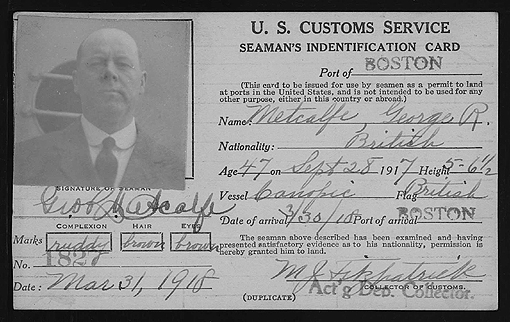
Captain Metcalfe's US Customs Seaman's ID Card (via FindMyPast).
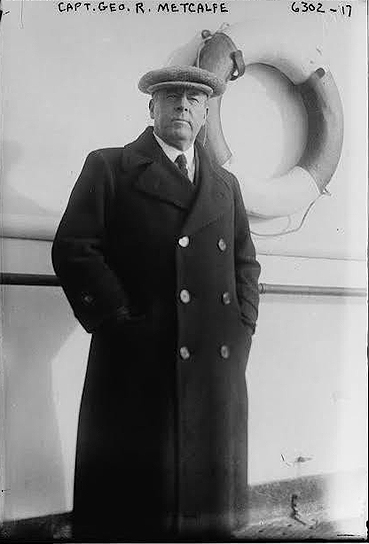
Captain Metcalfe (US Library of Congress)
Returning to sea shortly after his wife’s death, Captain Metcalfe spent a month commanding the RMS Baltic beginning on 26 October 1918. He next took command of the SS Ceramic, the largest ship in the White Star Line’s Australian fleet, where he played an active role in transporting troops home to Australia after World War I.[62.] Remaining with the Ceramic until 01 September 1920, he next spent eight days listed as the master of the USS Zeppelin.[63.] This vessel was a former German liner seized as a war reparation and handed to the White Star Line for management; however, given the brevity of this tenure, it is unclear whether he actually took her out on any voyages. He next spent a month commanding the RMS Adriatic before returning to the Ceramic for another nine months. Then, on 18 August 1921, he assumed command of the RMS Cedric, holding the helm longer than he had for any previous ship in his career up to that point.[64.] Despite the length of Captain Metcalfe’s time on the Cedric, his tenure in command was largely uneventful, with one exception. In December 1922, on a westbound voyage, the ship encountered the most violent storm he had witnessed in over twenty years of sailing.[65.] It was so violent that the crew wore oilskins and the passengers were kept below deck, with Captain Metcalfe noting that the only comparable gale he had ever faced occurred in the Indian Ocean two decades prior.[66.] Because of the extreme weather, the Cedric was slowed to just five knots and arrived in port two days behind schedule.[67.] After two and a half years on the Cedric, Captain Metcalfe took command of the RMS Homeric, then the world’s largest twin-screw steamer, in April 1924.[68.]
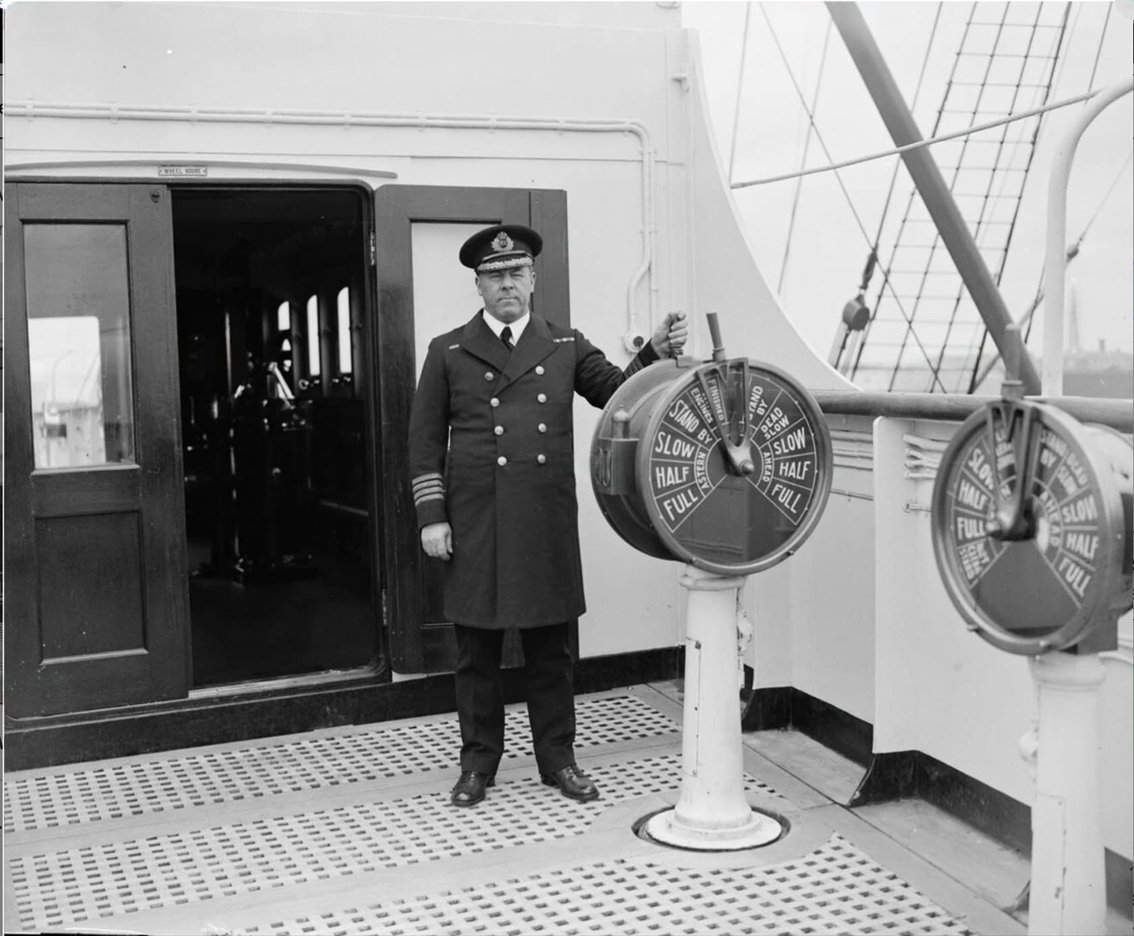
Captain Metcalfe on the bridge of the Homeric (Getty Images). (Click image to enlarge)
During his eight-month command of the Homeric, an anonymous Liverpool Evening Express journalist painted a colourful portrait of Captain Metcalfe, describing him as a deeply private man who “cares nothing for the limelight” and would prefer to command the ship entirely unseen.[69.] While playful gossip joked that he kept “human skulls” on the floor of his cabin to deter reporters from approaching the bridge, the article maintained that he was actually “one of the kindliest and friendliest commanders in the mercantile marine.”[70.] At the same time, a fierce and unwavering expression on his face made it clear that he tolerated zero hesitation in executing his orders.[71.] Because of this strict discipline, the profile concluded that the organisation aboard Metcalfe’s massive 35,000-ton liner was second to none.[72.]
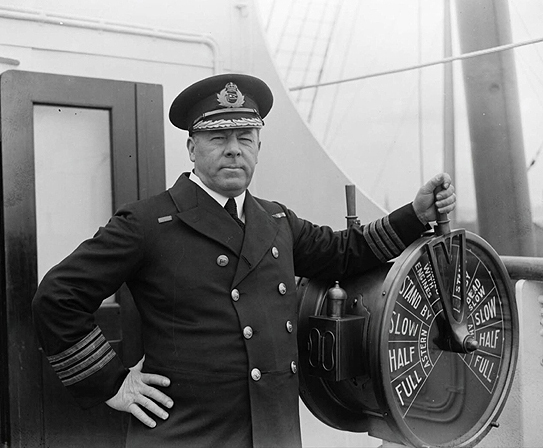
Captain Metcalfe on the bridge of the Homeric (Getty Images).
1924 brought several changes to the top command brass of the White Star Line, as the skippers of its two largest ships, Captain Sir Bertram Fox Hayes of the Majestic and Captain Frank Briscoe Howarth of the Olympic, both retired at year’s end upon reaching the company’s age limit of 60.
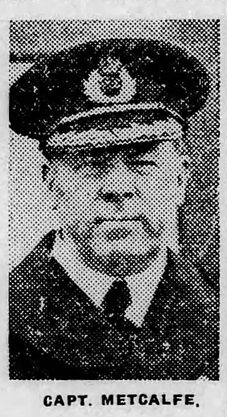
Liverpool Evening Express,
1 November 1924
The Homeric was the line’s third-largest ship and the original plan was for Captain Metcalfe to jump straight from the Homeric to the Majestic, but the temporary laying up of the latter ship in January 1925 changed those plans.[73.] As a result, Captain Metcalfe took temporary command of the Olympic on 04 January 1925 for a few round-trip voyages, marking a return to the ship that he had previously served as Assistant Commander of.[74.]
Although his tenure as the Olympic’s skipper was brief, one notable moment captured by cameras likely occurred then, as photos from The Kodak Magazine show Olympic’s harbour pilot George Bowyer (who had also been Titanic’s harbour pilot) on the bridge with the captain standing behind him.[75.] While the captain in the photo is not identified by name and no exact date beyond 1925 is given, the person clearly resembles Metcalfe more than Captain William Marshall, who succeeded him in command of the Olympic on 21 February 1925.[76.]
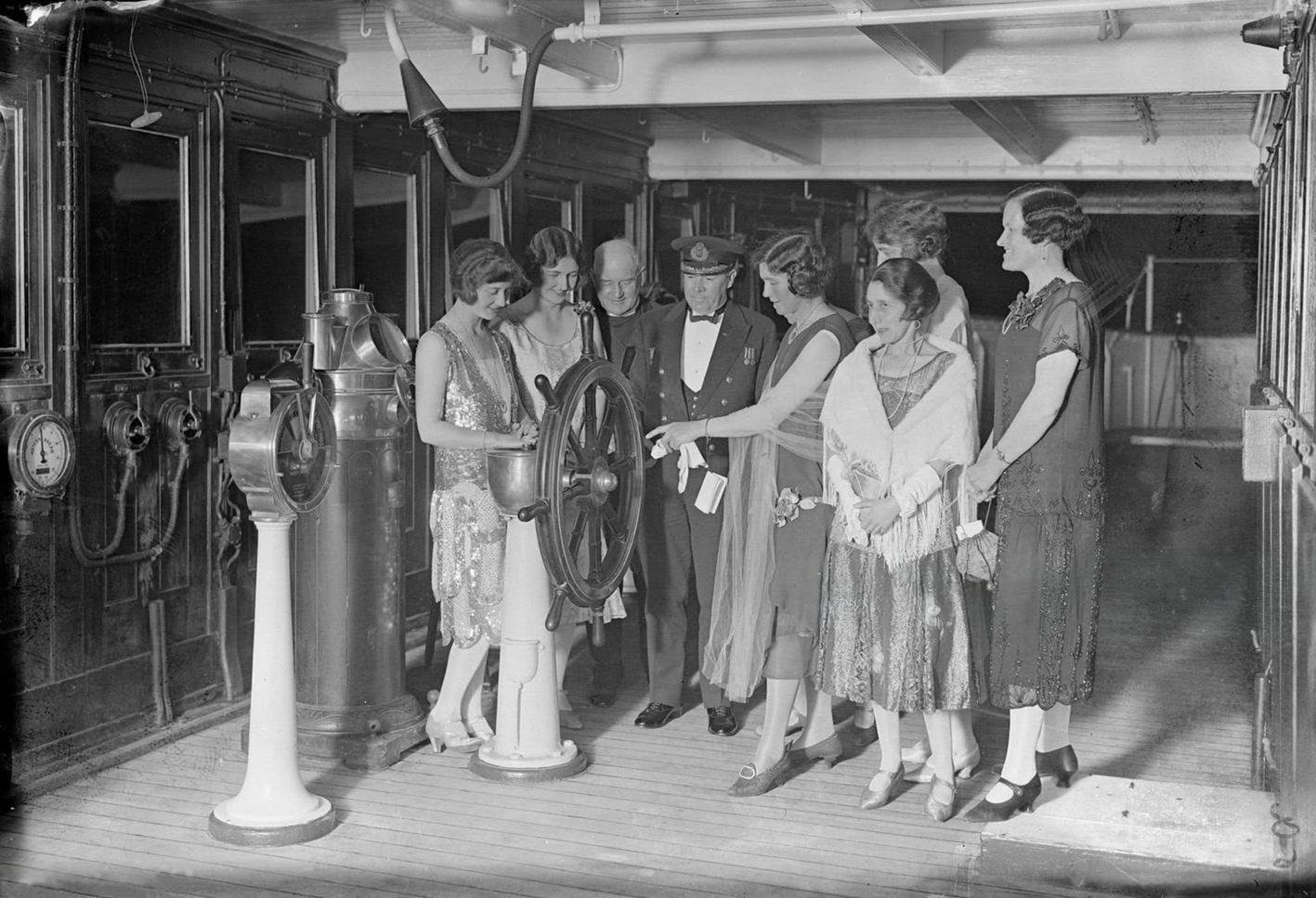
Captain Metcalfe explains the steering gear to a group of ladies on the bridge (Getty Images). (Click image to enlarge)
On 01 March 1925, Captain Metcalfe finally took command of the Majestic, the flagship of the White Star Line. The Majestic, along with the Cunard liner Berengaria and the United States Shipping Board’s Leviathan, were originally sister ships belonging to Germany’s Hamburg America Line before being seized by the Allies as reparations following World War I. While the owners of both the Majestic and the Leviathan claimed theirs was the largest ship in the world, Leviathan’s master, Captain Herbert Hartley, noted that he and Captain Metcalfe were “great friends” and never quarrelled over the title.[77.]
The first year under Metcalfe’s command brought both pleasant and stressful moments. In late July 1925, he had the honour of carrying the ship’s former master, Captain Sir Bertram Fox Hayes, back home to England as a first-cabin passenger.[78.] However, just over a month later, chaos struck when crew members walked off the job one day before the Majestic was scheduled to leave Southampton. Although last-minute replacements were found, the ship still sailed 150 men short and, because many of the striking workers were stokers and deckhands, officers and engineers had to step in to cover their duties.[79.] Despite the manpower shortage and bad weather approaching New York, the Majestic, carrying over 2,400 passengers, arrived only eight hours behind schedule on 08 September 1925.[80.] Upon docking, notable passengers, including Morris Hillquit, a former Socialist candidate for mayor of New York City, faced angry protesters heckling them for sailing on a “scab ship.”[81.] Another prominent traveller on board was Nathan Straus, the younger brother of Titanic victim Isidor Straus.[82.] To close out 1925, Captain Metcalfe earned a remarkable distinction when the Majestic pulled into Southampton on 12 December 1925 carrying a delegation of Sioux tribal leaders.[83.] Having previously known nothing larger than a canoe, the delegation expressed profound gratitude for his expert navigation by welcoming him into their community as an honorary member, complete with the distinguished title of “Chief Brave Heart.”

Two photographs showing harbour pilot George Bowyer on the bridge of the Olympic in 1925. Left: Bowyer, standing in the middle, with the Olympic's captain (likely Metcalfe) standing on the far right of the wing bridge. Right: Bowyer is seen inside the bridge standing at the telegraph, with the captain watching behind. Images from "The Pilot" by Robert M. Fanstone in "The Kodak Magazine", 1925, p 140. (Click image to enlarge)
The year 1926 introduced a unique blend of personal milestones and professional routines for Captain Metcalfe aboard the Majestic. Most notably, his son William, to whom he had penned a deeply affectionate letter nearly a decade prior, was now nineteen and actively pursuing a career at sea in his father’s footsteps. Working as a cadet aboard the Blue Funnel Line’s twin-screw steamer Keemun, the younger Metcalfe experienced a fortunate twist of fate in New York, where port schedules aligned just right to allow father and son to reunite while the Keemun loaded cargo alongside the arriving Majestic, on 09 March 1926.[84.] Towards the end of that year, a tragedy occurred on the Majestic, when wealthy Florida real estate developer David P. Davis died after jumping overboard from the ship. According to Captain Metcalfe, Mr. Davis “jumped through a cabin port,” but the circumstances surrounding his death, whether it was a suicide or a tragic accident, were never fully known. The year closed with a notable moment in December, when Captain Metcalfe had the honor of welcoming Prince Chichibu of Japan aboard the Majestic and guiding him through the ship's most intriguing features.[85.]
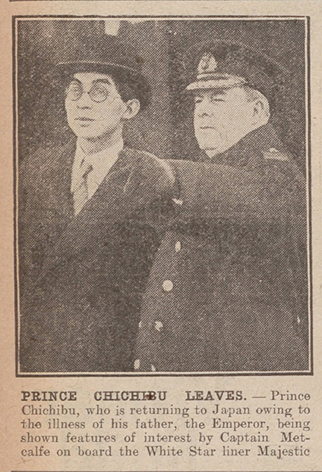
Daily Mirror, 09 March 1926.
1927 was Captain Metcalfe’s third year in command of the world’s largest ship. In May of that year, the public got a detailed glimpse into his personality through an interview with E.K. Titus of the Brooklyn Eagle. The conversation revealed a humble man who was amused by human nature, lightheartedly claiming that “every one is at heart a smuggler” and laughing at the idea of people trying to cheat customs.[86.] When he wasn’t dodging questions about Prohibition with a cheeky “that’s your funeral not mine,” Metcalfe showed a reflective side that stood in contrast to the high-society glamour of his ship. He preferred substantive history books, like Ancient Cities and Modern Tribes, over fiction, a passion for history that began with his access to the vicar’s library as a boy.[87.]
He approached the gruelling demands of his job with genuine energy, famously asserting that for anyone drawn to the ocean, hard work is just struggle, and “struggle is life!”[88.] This easygoing outlook extended to his passengers as well. Rather than judging the young “flapper” crowd, he adopted a warm “live and let live” philosophy, noting that we should all look back sympathetically on the time when we were young.[89.] Avoiding heavy vices or fancy tastes, he found a simple, boyish contentment in the sea and had a surprising favourite drink: plain water, which he called “a jolly good drink.”[90.]
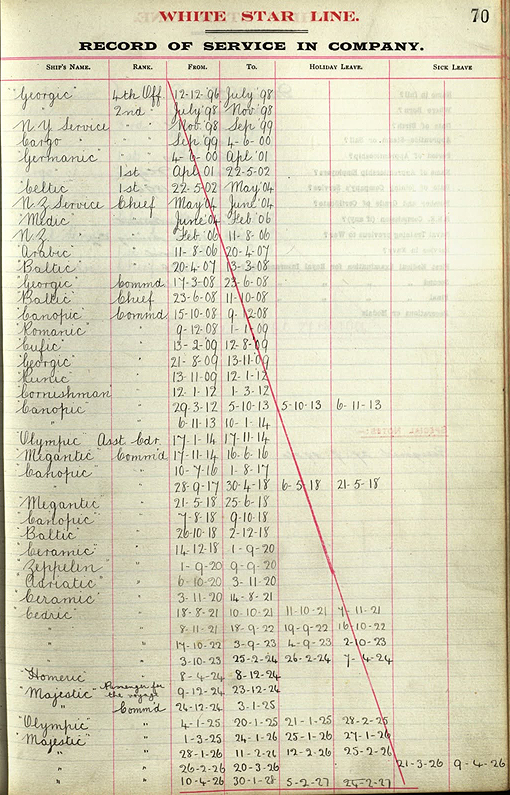
Metcalfe's White Star record, listing many the ships he worked aboard.
Despite his zeal for the “struggle” of sea life, the physical cost of command eventually became unavoidable. In April 1928, a twenty-day sick leave provided a glimpse of the health struggles that would soon define Metcalfe’s final months at sea.[91.] He returned to the Majestic for a final period of command, but by 02 September 1928, he was once again forced to step aside.[92.] With the ship set to sail three days later, Assistant Commander Robert Hume stepped in, taking a record 2,593 passengers across the ocean.[93.] The official conclusion to his career arrived on 19 October 1928, when a cable dispatch from Liverpool confirmed that due to gastritis, Metcalfe had retired from active service.[94.] He was succeeded on the bridge of the Majestic by Captain William Marshall, who had previously succeeded him on the Olympic.[95.] Because of his long and meritorious service with the company for thirty-two years, the White Star Line ensured he would remain on full pay until he reached the age limit of sixty at the end of 1930.[96.]
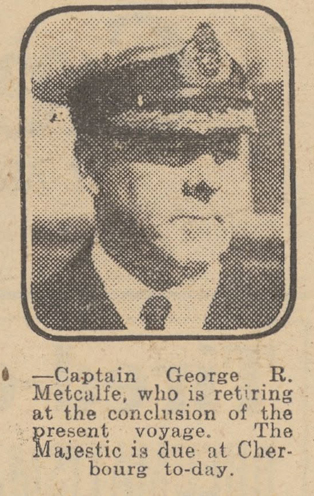
Daily Mirror, 12 October 1928
Metcalfe’s retirement on the grounds of ill health sparked a wider, more sobering conversation about the gruelling nature of the profession. His departure, alongside the breakdowns of other prominent commanders, led observers to question if the strain of managing the world’s largest liners had become unsustainable.[97.] To these observers, the cases of Captains William R.D. Irvine and Charles A. Smith of the Cunard liner Berengaria, and the tragic collapse of Captain Sir James T.W. Charles on the bridge of the Cunard liner Aquitania on the very day of his retirement, served as grim evidence.[98.] The industry was shifting as oil-burning ships allowed for faster turnarounds, meaning captains spent more time at sea and less time resting ashore.[99.] Between the crushing responsibility of manoeuvring 50,000-ton vessels and the mental exhaustion of standing on the bridge for days on end during heavy fog, the “arduous task” of the modern commander was beginning to break even the strongest men.[100.] To help ease their strain, Cunard appointed a permanent relief captain for their biggest ships.[101.] The White Star Line eventually did the same in 1930, with the role being filled by Captain Edgar Lakeman Trant.[102.]
Retirement did indeed ease the strain on Metcalfe’s body. He left the bustle of Liverpool for the tranquillity of Anglesey, Wales, settling first in Beaumaris and later in Menai Bridge.[103.] Consistent with his unassuming personality, he spent his later years away from the spotlight, as unlike many other retired captains who frequently appeared as passengers on their former ships, Metcalfe’s name is notably absent from the manifests of the vessels he once commanded. His later years were defined by the quiet rhythms of family life. In Beaumaris on 26 April 1933, his daughter Elizabeth married and became Mrs. Frank Coulthard.[104.] She died in 1986. His son, William, married the former Constance Johnstone in November and eventually left the sea for reasons unknown, as by the 1939 register, his occupation was listed as “motor driver”.[105.] He died in January 1988.
Captain Metcalfe himself lived a long life of quiet contentment until his death on 02 February 1945 at the age of 74. Upon his death, he was interned at Llandysilio with the Rev. Trevor Jones officiating his funeral and his effects, valued at £2896.14, were given to his son William.[106.] Overall, Captain George Robert Metcalfe was the embodiment of the man described during his time on the Homeric as one who “plods constantly onward,” avoiding the “meteoric” flash of those whose careers are built on spectacle.[107.] Because his tenure was defined by a lack of accidents and a steady, reliable hand, he has largely been forgotten by history. But his record, spanning Admiralty medals, the congressional recognition for the Denver rescue, and the Royal Humane Society’s recognition, makes him one of the most accomplished shipmasters in the history of the White Star Line.
Note: Click the return (arrow) symbol to return to the main text.
1. 1871 United Kingdom census (via FindMyPast.co.uk). ↩
2. “Every One a Smuggler at Heart- No Criminal Intent but Most Folks Seem Proud of Small Accomplishments, Observes Captain”, Brooklyn Eagle, 08 May 1927 (via newspapers.com). ↩
3. “Vicar Gray of Helmsley”, Temple Moore Trail (via templemooretrail.co.uk). ↩
4. Ibid. ↩
5. Brooklyn Eagle, 08 May 1927. ↩
6. Ibid. ↩
7. Ibid. ↩
8. George Robert Metcalfe, Masters Certificate No. 023469, UK and Ireland, Masters and Mates Certificates, 1850-1927 (via Ancestry.com). ↩
9. Masters Certificate No. 023469 & “Sea Captains’ Careers. No 49- Capt. G.R. Metcalfe, Lieut-Commander R.N.R.”, Hampshire Advertiser, 10 May 1924 (via FindMyPast.co.uk). ↩
10. Masters Certificate No. 023469 & “The Commander of the Ceramic”, Daily Commercial News, 19 January 1921 (via newspapers.com). ↩
11. “Sea Captains’ Careers. No 49- Capt. G.R. Metcalfe, Lieut-Commander R.N.R.”, Hampshire Advertiser, 10 May 1924 (via FindMyPast.co.uk). ↩
12. George Robert Metcalfe, Masters Certificate No. 023469, UK and Ireland, Masters and Mates Certificates, 1850-1927 (via Ancestry.com). ↩
13. “Sea Captains’ Careers. No 49- Capt. G.R. Metcalfe, Lieut-Commander R.N.R.”, Hampshire Advertiser, 10 May 1924 (via FindMyPast.co.uk). ↩
14. Metcalfe, George Robert, ADM 340/96/35, The National Archives, Kew (via discovery.nationalarchives.gov.uk). ↩
15. “The Commander of the Ceramic”, Daily Commercial News, 19 January 1921 (via newspapers.com). ↩
16. Metcalfe, George Robert, ADM 340/96/35, The National Archives, Kew (via discovery.nationalarchives.gov.uk). ↩
17. Ibid. ↩
18. Liverpool, England, Crew Lists, 1861-1919 (via Ancestry.com, courtesy of Daxton Geisler). ↩
19. Metcalfe, George Robert, ADM 340/96/35, The National Archives, Kew (via discovery.nationalarchives.gov.uk). ↩
20. Tony Goulding, “Greetings from Naples … another story from Tony Goulding,” Chorlton History (blog by Andrew Simpson), 12 November 2023 (via https://chorltonhistory.blogspot.com/2023/11/greetings-from-naples-another-story.html). ↩
21. Ibid. ↩
22. Metcalfe, George Robert, ADM 340/96/35, The National Archives, Kew (via discovery.nationalarchives.gov.uk). ↩
23. Ibid. ↩
24. Ibid. ↩
25. Tony Goulding, “Greetings from Naples … another story from Tony Goulding,” Chorlton History (blog by Andrew Simpson), 12 November 2023 (via https://chorltonhistory.blogspot.com/2023/11/greetings-from-naples-another-story.html). ↩
26. Metcalfe, George Robert, ADM 340/96/35, The National Archives, Kew (via discovery.nationalarchives.gov.uk). ↩
27. Ibid. ↩
28. Ibid. ↩
29. Ibid. ↩
30. 1939 United Kingdom register (via FindMyPast.co.uk). ↩
31. Metcalfe, George Robert, ADM 340/96/35, The National Archives, Kew (via discovery.nationalarchives.gov.uk). ↩
32. Ibid. ↩
33. “Canopic's Course Altered,” Boston Evening Transcript, 24 April 1912 (via newspapers.com). ↩
34. “Will Be Room for All in Lifeboats: Steamship Canopic Is to Limit Passengers,” The Boston Globe, 25 April 1912 (via newspapers.com). ↩
35. “Canopic's Course Altered,” Boston Evening Transcript, 24 April 1912 (via newspapers.com). ↩
36. “Will Be Room for All in Lifeboats: Steamship Canopic Is to Limit Passengers,” The Boston Globe, 25 April 1912 (via newspapers.com). ↩
37. Boston Globe, 25 April 1912 & “Told of Titanic: No Suppression of News on Steamer Canopic,” The Ottawa Citizen, 27 April 1912 (via newspapers.com). ↩
38. Boston Globe, 25 April 1912. ↩
39. Metcalfe, George Robert, White Star Line Officers’ Books (via FindMyPast.co.uk). ↩
40. Mark Chirnside, RMS Olympic: Titanic's Sister (Stroud, Gloucestershire: The History Press, 2015), page 175. ↩
41. Chirnside, RMS Olympic: Titanic's Sister, page 175 & “An “Assistant Commander” For the Olympic,” London Daily Chronicle, 17 January 1914 (via newspapers.com). ↩
42. Mark Chirnside, RMS Olympic: Titanic's Sister (Stroud, Gloucestershire: The History Press, 2015), page 191. ↩
43. Chirnside, RMS Olympic: Titanic's Sister, page 191 & “About People.” The Australian, 11 February 1921 (via newspapers.com). ↩
44. “Roughest Trip on Record” Belfast Evening Telegraph, 21 January 1915 (via newspapers.com). ↩
45. “Wireless Saves Another Steamer,” Holyoke Daily Transcript-Telegram, 24 March 1915 (via newspapers.com). ↩
46. “Gallant Rescue At Sea: White Star Liner’s Race Through a Gale” Manchester Courier and Lancashire General Advertiser, 07 January 1916 (via newspapers.com). ↩
47. Father Neptune, “Sea Captains' Careers: No. 49- Capt. G. R. Metcalfe, Lieut-Commander R.N.R.,” Hampshire Advertiser, 10 May 1924 (via FindMyPast.co.uk). ↩
48. Hampshire Advertiser, 10 May 1924 & “Gallant Rescue At Sea: White Star Liner’s Race Through a Gale” Manchester Courier and Lancashire General Advertiser, 07 January 1916 (via newspapers.com). ↩
49. “Megantic Eluded Foe's Submarines,” The Gazette (Montreal), 07 June 1915 (via newspapers.com). ↩
50. Ibid. ↩
51. Metcalfe, George Robert, White Star Line Officers’ Books (via FindMyPast.co.uk). ↩
52. “Kingstonian Not a U-Boat Victim,” Boston Post, 13 October 1916 (via newspapers.com). ↩
53. Ibid. ↩
54. “Canopic Reaches Boston,” The Patriot Ledger, 14 February 1917 (via newspapers.com). ↩
55. Ibid. ↩
56. Tony Goulding, “Greetings from Naples … another story from Tony Goulding,” Chorlton History (blog by Andrew Simpson), 12 November 2023 (via https://chorltonhistory.blogspot.com/2023/11/greetings-from-naples-another-story.html). ↩
57. Metcalfe, George Robert, White Star Line Officers’ Books (via FindMyPast.co.uk). ↩
58. Ibid. ↩
59. England & Wales Government Probate Death Index, 1858-2019, s.v. "Elizabeth Metcalfe," death date: 04 October 1918, probate date: 30 October 1918, Liverpool, Lancashire, England (via FindMyPast.co.uk) & “The Commander of the Ceramic”, Daily Commercial News, 19 January 1921 (via newspapers.com). ↩
60. “The Commander of the Ceramic”, Daily Commercial News, 19 January 1921 (via newspapers.com). ↩
61. Tony Goulding, “Greetings from Naples … another story from Tony Goulding,” Chorlton History (blog by Andrew Simpson), 12 November 2023 (via https://chorltonhistory.blogspot.com/2023/11/greetings-from-naples-another-story.html). ↩
62. Metcalfe, George Robert, White Star Line Officers’ Books (via FindMyPast.co.uk). ↩
63. Ibid. ↩
64. Ibid. ↩
65. “Terrific Storm Lashes Atlantic into Great Fury,” Battle Creek Enquirer, 26 December 1922 (via newspapers.com). ↩
66. Ibid. ↩
67. “Liners Late in Arriving at New York as a Result of Heavy Storms on Atlantic,” The Moncton Transcript, 26 December 1922 (via newspapers.com). ↩
68. “By One Who Knows Him, Metcalfe of the ‘Homeric’,” Liverpool Evening Express, 01 November 1922 (via newspapers.com). ↩
69. Ibid. ↩
70. Ibid. ↩
71. Ibid. ↩
72. Ibid. ↩
73. “Olympic's Commander: Captain Metcalfe Takes Temporary Control,” Southampton Times and Hampshire Express, 10 January 1925 (via newspapers.com). ↩
74. Ibid. ↩
75. “The Pilot,” The Kodak Magazine, 1925 (via TitanicOfficers.com). ↩
76. Marshall, William, White Star Line Officers’ Books (via FindMyPast.co.uk). ↩
77. E. K. Titus, “King of a Sea-Going Realm,” Brooklyn Eagle, 15 May 1927 (via newspapers.com). ↩
78. “Hayes on Ship: Former Captain of Vessel Watches Successor,” The Miami News, 02 August 1925 (via newspapers.com). ↩
79. “Juniors Keep Watch: Police Hoodwink Communists Who Held Demonstration Against Actress,” Daily Mirror, 09 September 1925 (via newspapers.com). ↩
80. “Majestic Here on Time Despite Crew's Strike,” Daily News (New York), 09 September 1925 (via newspapers.com). ↩
81. Ibid. ↩
82. Ibid. ↩
83. “Capt. G. Metcalfe a Sioux Chief: Indians Honour Majestic's Skipper,” Liverpool Evening Express, 12 December 1925 (via newspapers.com). ↩
84. “Freighter Arrives and Lands Cotton for Distant Ports,” Staten Island Advance, 09 March 1926 (via newspapers.com). ↩
85. “Prince Chichibu Leaves,” Daily Mirror, 09 March 1926 (via newspapers.com). ↩
86. “Every One a Smuggler at Heart- No Criminal Intent but Most Folks Seem Proud of Small Accomplishments, Observes Captain”, Brooklyn Eagle, 08 May 1927 (via newspapers.com). ↩
87. Ibid. ↩
88. Ibid. ↩
89. Brooklyn Eagle, 08 May 1927. ↩
90. Ibid. ↩
91. Metcalfe, George Robert, White Star Line Officers’ Books (via FindMyPast.co.uk). ↩
92. Ibid. ↩
93. “2,593 on Majestic, a Record Since War,” The Evening Sun (Hanover, PA), 12 September 1928 (via newspapers.com). ↩
94. “Capt. Metcalfe of White Star Ill.,” The New York Times, 30 September 1928 (via nytimes.com). ↩
95. Ibid. ↩
96. Ibid. ↩
97. “Liner Captain's Task Is Arduous,” The Montreal Star, 09 November 1928 (via newspapers.com). ↩
98. Ibid. ↩
99. Ibid. ↩
100. Ibid. ↩
101. Ibid. ↩
102. “Round the Port,” Southern Daily Echo, 13 December 1930 (via newspapers.com). ↩
103. Metcalfe, George Robert, ADM 340/96/35, The National Archives, Kew (via discovery.nationalarchives.gov.uk). ↩
104. “England and Wales, National Register, 1939,” entry for Elizabeth Coulthard, 29 September 1939, Menai Bridge, Anglesey, Wales (via familysearch.org). ↩
105. Tony Goulding, “Greetings from Naples … another story from Tony Goulding,” Chorlton History (blog by Andrew Simpson), 12 November 2023 (via https://chorltonhistory.blogspot.com/2023/11/greetings-from-naples-another-story.html) & 1939 United Kingdom register (via FindMyPast.co.uk). ↩
106. “England & Wales Government Probate Death Index 1858-2019” and “England & Wales Deaths 1837-2007,” entries for George Robert Metcalfe, 1945, Anglesey, Wales (via FindMyPast.co.uk). & “Former Captain of the Majestic’,” Holyhead Anglesey Mail, 09 February 1945 (via newspapers.com). ↩
107. “By One Who Knows Him, Metcalfe of the ‘Homeric’,” Liverpool Evening Express, 01 November 1922 (via newspapers.com). ↩
If this website has been of some help, please consider supporting it with a coffee
to ensure it can continue. It can be anonymous. Anything helps!: