Date of birth: 4th November 1857 Place of birth: Weymouth, Nova Scotia Marital status: Married Age: 54 (in 1912) Spouse: Laleah Abigail Haines Children: Thomas Wayland (1880–1963), William Judson (1885–1948), Lilly Gladys(1887–1959), David Arnold (1889–1954), Hazel Olive (1893–1894), Margherita (1894–1973), Edgar William (1897–1976), Albert Ernest (1902–1984) Crew position: Chief Officer (Carpathia, 1912) Date of death: 21 April 1936 (age 78)
In 1839, Samuel Cunard was awarded the first British transatlantic steamship mail contract, and the next year formed the British and North American Royal Mail Steam-Packet Company in Glasgow with shipowner Sir George Burns together with Robert Napier, the famous Scottish steamship engine designer and builder, to operate the line's four pioneer paddle steamers on the Liverpool–Halifax–Boston route. For most of the next 30 years, Cunard held the Blue Riband for the fastest Atlantic voyage. However, in the 1870s Cunard fell behind its rivals, the White Star Line and the Inman Line. To meet this competition, in 1879 the firm was reorganised as the Cunard Steamship Company Ltd, to raise capital. In 1919, Cunard relocated its British homeport from Liverpool to Southampton, to better cater for travellers from London.
(Source: Wikipedia)
Chief Officer Thomas Hankinson - Cunard
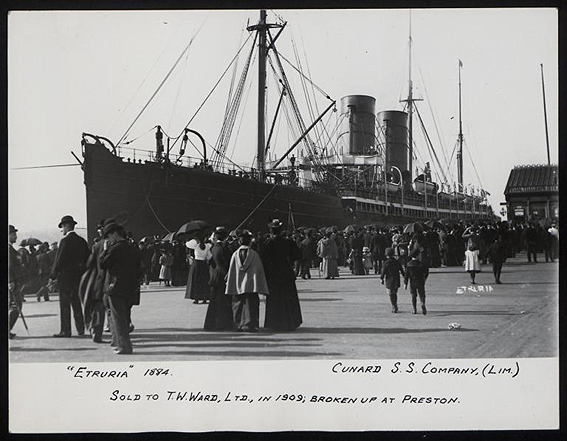
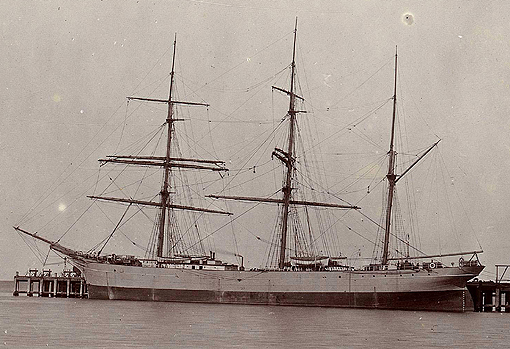
The RMS Etruria in 1884, likely the first Cunard ship Hankinson worked aboard as Fourth Officer. The Etruria was built in 1884 and fitted with auxiliary sails. (Credit: Liverpool Maritime Museum).
Change was afoot - and one that would affect his life dramatically. In 1895 Hankinson decided to join the Cunard Line. According to an unidentified newspaper article quoted at Encyclopedia Titanica, "in 1895, he joined the Cunard Line as 4th Officer on the 'Servia' (launched 1881), dropping rank to gain experience in steam. Then he became an Officer on the 'Aurania', 'Pavenia' and 'Lucania'." However his RNR records, which provide much detail as to the merchant ships he worked aboard, does not record the Servia but instead states he dropped a rank to first become Fourth officer aboard the Cunard ship the Etruria, on Liverpool to New York service, on the 7th of January 1895. By June he was Third Officer and switched to the Aurania, and then in August he was working aboard the Pavonia also as Third Officer. The following year he was then aboard Cunard's Lucania on the Liverpool to New York service, as Third and then Second Officer - finally making the rank of a senior officer. By 1897 he was firmly staying as Second Officer aboard the Lucania, remaining there until the end of 1897.
Meanwhile, on the 22 August 1897 the family welcomed the birth of a son Edgar William (1897–1976). The crew agreement for the Lucania dated the 11 of September 1896 reveals that the 37 year old Second officer was living with family at 37 Eaton Ave, Seaforth, Liverpool.
It looked as though he would be stuck in the role of Second Officer for some time. In 1898 and 1899 he was in that capacity aboard the Lucania's older sister ship the Campania, and it wasn't until the turn of the century on the 30th of March 1900 that was briefly listed as First Officer aboard the Campania, repeating the process again the following year when was briefly First Officer on the 6th of Feberuary 1901.
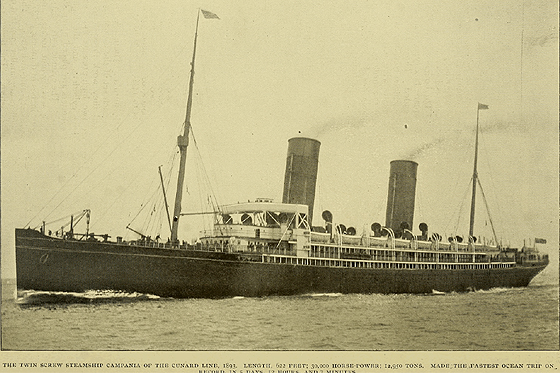
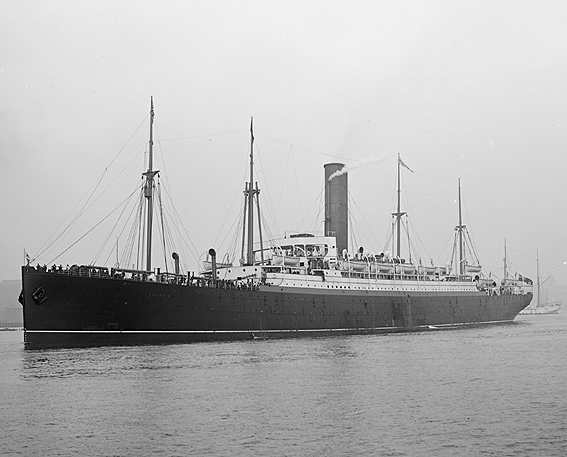
The RMS Campania was launched in 1892 and was the largest and fastest passenger liner afloat when she entered service in 1893 (Credit: Liverpool Maritime Museum).
While working aboard the Campania he was involved in a collision that resulted in a sinking of another vessel and loss of life. On 21 July 1900, the Campania sank the British barque Embleton in a collision 30 miles (48 km) north east of the Tuskar Light in the Irish Channel.
According to Wrecksite.eu, "on July 21st, 1900, when on voyage with general cargo from Liverpool to Dunedin and Wellington, New Zealand, EMBLETON collided with the liner CAMPANIA in foggy weather, 26 miles NE of Tuskar. The EMBLETON broke in two pieces and 11 people lost their lives. Read more at wrecksite: (Source: https://www.wrecksite.eu/wreck.aspx?173590). The National Marine Engineers Beneficial Association of July 1910 added that the Embleton was "loaded with dynamite and sank in exactly 80 seconds."
The RMS Campania sank the British barque Embleton which was loaded with dynamite. (Credit:wrecksite.eu).
In 1901 the Campania was fitted with a Marconi wireless system, to match her sister the Lucania who had become the first Cunard ship to have the technology. Shortly after the two sisters made history by exchanging a wireless message regarding ice, with the Campania becoming the first ship in 1905 to have a permanent radio connection to coastal stations. ("Wireless at Sea" by Hancock, H.E. 1950, Chelmsford: Marconi International Marine Communication Company.)
Hankinson's RNR records reveal that by 1900 he was living at 151 Hornby Rd, Bootle, Liverpool. This is confirmed by the 1901 census that lists him as residing as the head of the house ("officer on steamer -sub-lieut. R.N.R.") at Bootle cum Linacre, Lancashire, aged 44, with the address listed as 151 Hornby Road, a residential property located in Bootle, Liverpool (L20 5BZ). The family consisted of his wife, Laleah age 42, son Thomas 21, daughter Lily 13, David 11, Margherita 6 and Edgar 3. The son Thomas was registered as an apprentice mechanical engineer. In 1902 the last of their eight children arrived, with son Albert Ernest (1902–1984) born on the 4th of January.
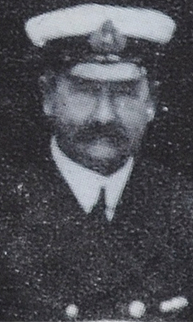
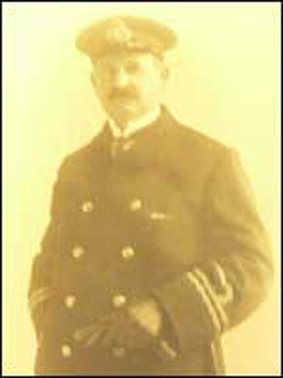
Hankinson in uniform (BBC/Josephine Hearne).
He continued as Second Officer aboard the Campania in 1902 and 1903 until the 11th of April 1903 and he finally was promoted to First Officer and intermittently worked in that position through the remainder of that year.
There is a claim by Encyclopedia Titanica contributor Julian Atkins that "often overlooked is that the Carpathia Chief Officer Hankinson was Lightoller's best man at his wedding, and later on I suggest was the source for Lightoller's condemnation of The Californian in his own 1935 autobiography and the 1936 BBC radio interview." (Encyclopedia Titanica forum, January 3, 2020). However Charles Lightoller was married in Sydney, Australia on the 15th of December 1903. There is no record of Hankinson being in Australia at this time (or ever on an Australian service), but instead working the transatlantic route aboard Cunard's Campania. It is most likely confusing Hankinson with First Officer Horace Dean who briefly worked for the White Star Line. However the newly married Lightollers did move to Crosby so they would have possibly been neighbours with the Hankinsons. (As an aside: There is also a photograph of Hankinson with Lightoller and Rostron aboard the Carpathia after the Titanic sank, which may indicate they knew each other.)
A change to a new ship, the Saxonia (on the Liverpool–Boston route) on the 12th of February 1904 also brought a promotion: to Chief Officer, a position he retained for the remainder of his career with the exception of briefly in August 1905 when he became the Lucania's First Officer. Otherwise he stayed as chief aboard the Laconia, Slavonia and Saxonia from 1904 through to 1908. On the 13th of April he also received a Lieutenant commission (01221) in the RNR.
Aboard the Cunard's RMS Saxonia Hankinson became Chief Officer.
In 1909 he became the Chief Officer of a ship that would become famous: the Cunard's Carpathia, with entries showing in his RNR records for the 13th of February 1909 through to the 7th of February 1912. Conversely, the unidentified newspaper source for the Encyclopedia Titanica entry gives an alternate account: "He eventually rejoined the 'Servia' as 1st Officer. In 1911, he became Captain of the 'Lycia' visiting Mediterranean ports, and later that year became Captain of the 'Cypria'." However there is no evidence in his extensive RNR records that he was ever Captain prior to becoming the Carpathia's Chief Officer - or thereafter.