Date of birth: 4th November 1857 Place of birth: Weymouth, Nova Scotia Marital status: Married Age: 54 (in 1912) Spouse: Laleah Abigail Haines Children: Thomas Wayland (1880–1963), William Judson (1885–1948), Lilly Gladys(1887–1959), David Arnold (1889–1954), Hazel Olive (1893–1894), Margherita (1894–1973), Edgar William (1897–1976), Albert Ernest (1902–1984) Crew position: Chief Officer (Carpathia, 1912) Date of death: 21 April 1936 (age 78)
In 1839, Samuel Cunard was awarded the first British transatlantic steamship mail contract, and the next year formed the British and North American Royal Mail Steam-Packet Company in Glasgow with shipowner Sir George Burns together with Robert Napier, the famous Scottish steamship engine designer and builder, to operate the line's four pioneer paddle steamers on the Liverpool–Halifax–Boston route. For most of the next 30 years, Cunard held the Blue Riband for the fastest Atlantic voyage. However, in the 1870s Cunard fell behind its rivals, the White Star Line and the Inman Line. To meet this competition, in 1879 the firm was reorganised as the Cunard Steamship Company Ltd, to raise capital. In 1919, Cunard relocated its British homeport from Liverpool to Southampton, to better cater for travellers from London.
(Source: Wikipedia)
Chief Officer Thomas Hankinson - Titanic Disaster
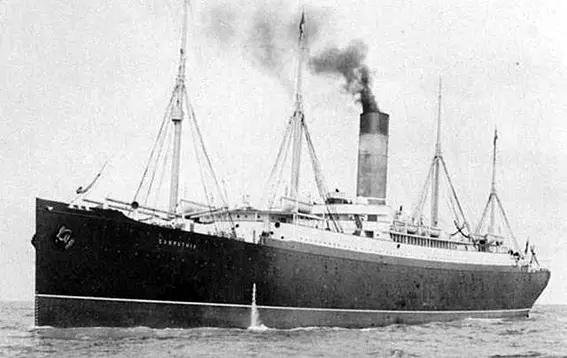
The Cunard liner RMS Carpathia at sea.
In his third year of working aboard the Carpathia, and under Captain Arthur Rostron's command, Hankinson was likely off-duty when Titanic's distress calls were received by wireless operator Harold Cottam just after midnight on the 15th of April 1912. Rostron was asleep but was awakened by Cottam with the urgent message. In turn Rostron rounded up his senior officers. Rostron later recalled: "I sent for the chief officer, giving him the position of the Titanic and instructions to alter our course." (Daily Mirror, 6 May 1912) Second Officer Bisset remembered that Hankinson was put in charge by Rostron of organising the boat deck. "The Chief Officer attended to details on deck, telling us off for the various duties, while more and more orders flowed from the Captain." ("Tramps and Ladies" by Sir James Bisset, 1959)
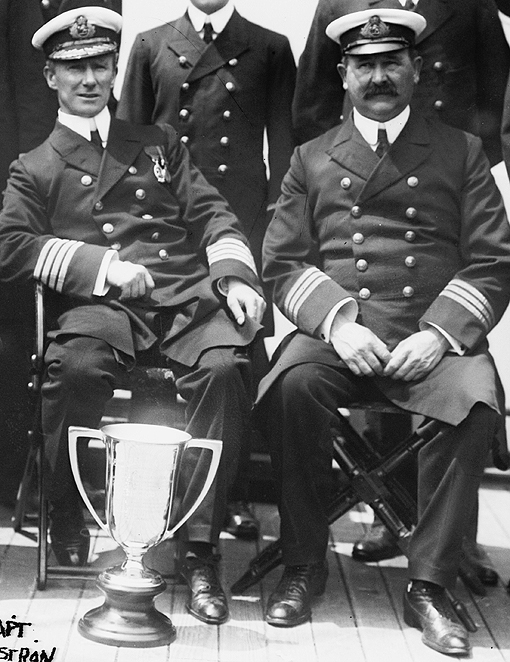
Chief Officer Thomas Hankinson (right) in 1912, alongside Captain Arthur Rostron.
At 4am Hankinson took over from First Officer Dean as Officer of the Watch on the bridge - and it was a pivotal moment as that was also when the Carpathia encountered the first of Titanic's lifeboats: "First Officer Dean was relieved on the bridge by Chief Officer Hankinson. At that moment, in the dim gray light of dawn, we sighted a lifeboat a quarter of a mile away." ("Tramps and Ladies" by Sir James Bisset, 1959)
Hankinson would undoubtedly have been busy on the bridge adjusting the helm to ensure they met with each lifeboat safely, liaising continuously with Captain Rostron and the helmsman to avoid the icebergs in the area. He was also most likely on watch when Fourth Officer Boxhall came up to the bridge to report what had happened. Boxhall recalled: "I went up to the Captain, Captain Rostron, on the bridge. And he said, “Where is the ship?” I said, “she's sunk.” And I said, “I don't know where the other boats are, I've not seen them, they're all to the southward of us somewhere.”(1962 BBC Broadcast). Carpathia's Second Officer Bissett also recalled this moment:
Second officer James Bisset (here pictured in 1906) of the Carpathia wrote about picking up Boxhall and boat no.2. (Click to enlarge)
The officer was a young man, Joseph Boxhall, Fourth Officer of the Titanic. I took him up to the bridge, to report to our Captain. Without preliminaries, Rostron burst out, excitedly, "Where is the Titanic?"
"Gone!" said Boxhall. "She sank at 2.20 A.M."
In the moment of stunned silence that followed, every man on the bridge of the Carpathia could envisage the appalling reality, but not yet to its fullest extent. It was now 4.20 A.M.
Boxhall added, in a voice of desperation, "She was hoodoo'd from the beginning. . . ."
Captain Rostron took the young officer by the arm, and said quietly and kindly to him, "Never mind that, m'son. Tell me, were all her boats got away safely?"
"I believe so, sir. It was hard to see in the darkness. There were sixteen boats and four collapsibles. Women and children were ordered into the boats. She struck the berg at 11.40. The boats were launched from 12.45 onwards. My boat was cleared away at 1.45, one of the last to be lowered. Many of the boats were only half full. People wouldn't go into them. They didn't believe that she would sink . ."
"Were many people left on board when she sank?"
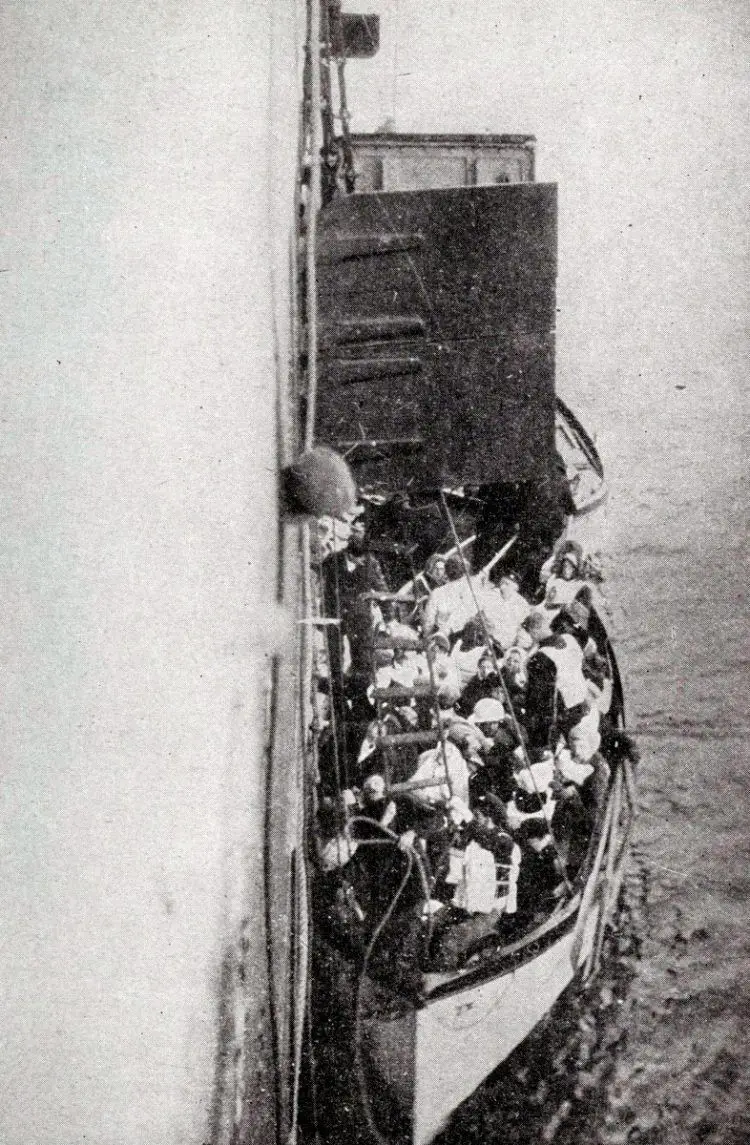
Lifeboat no.11 with passengers using a ladder to get onboard the Carpathia. (Click image to enlarge)
"Hundreds and hundreds! Perhaps a thousand! Perhaps more!" Boxhall's voice broke with emotion. "My God, sir, they've gone down with her. They couldn't live in this icy cold water. We had room for a dozen more people in my boat, but it was dark after the ship took the plunge. We didn't pick up any swimmers. I fired flares ... I think that the people were drawn down deep by the suction. The other boats are somewhere near. . . ."
"Thank you, Mister," said Rostron. "Go below and get some coffee, and try to get warm."
("Tramps and Ladies" by Sir James Bisset, P.R.Stephensen, 1959)
Hankinson's granddaughter Josephine Hearne from Bromsgrove, UK related what she knows of his actions: "They were 58 miles away, and my Grandfather was the Chief Officer and so he was responsible for the deck rescue and all that had to be done. Don’t forget they were expecting to find the Titanic still floating – they thought it had just foundered. They did not believe the ship, which they believed to be unsinkable, could possibly have sunk without trace." (BBC "Memories of a Titanic hero")
According to Encyclopedia Titanica "His great-grandson, Justin William Hankinson, holds the telescope that Chief Officer Hankinson used to search for the Titanic lifeboats."
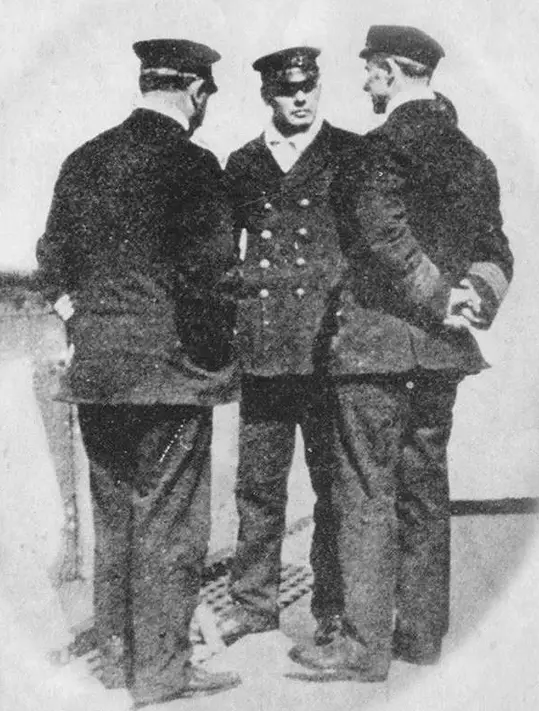
Hankinson's four hour shift - likely one of the most memorable watches he ever experienced as 712 survivors were picked up from the disaster area - came to an end at 8am when he was relived by Bisset himself: "I took over the watch on the bridge from Chief Officer Hankinson. It was of no importance that I had gone without sleep all night" ("Tramps and Ladies" by Sir James Bisset, 1959). It is likely Hankinson also forgoed sleep on that eventful day. He was photographed talking with the senior surviving officer of the Titanic disaster, Second Officer Charles Lightoller, along with Captain Arthur Rostron. He has his back turned to the camera, but they appear engrossed in talk with no doubt many questions asked.
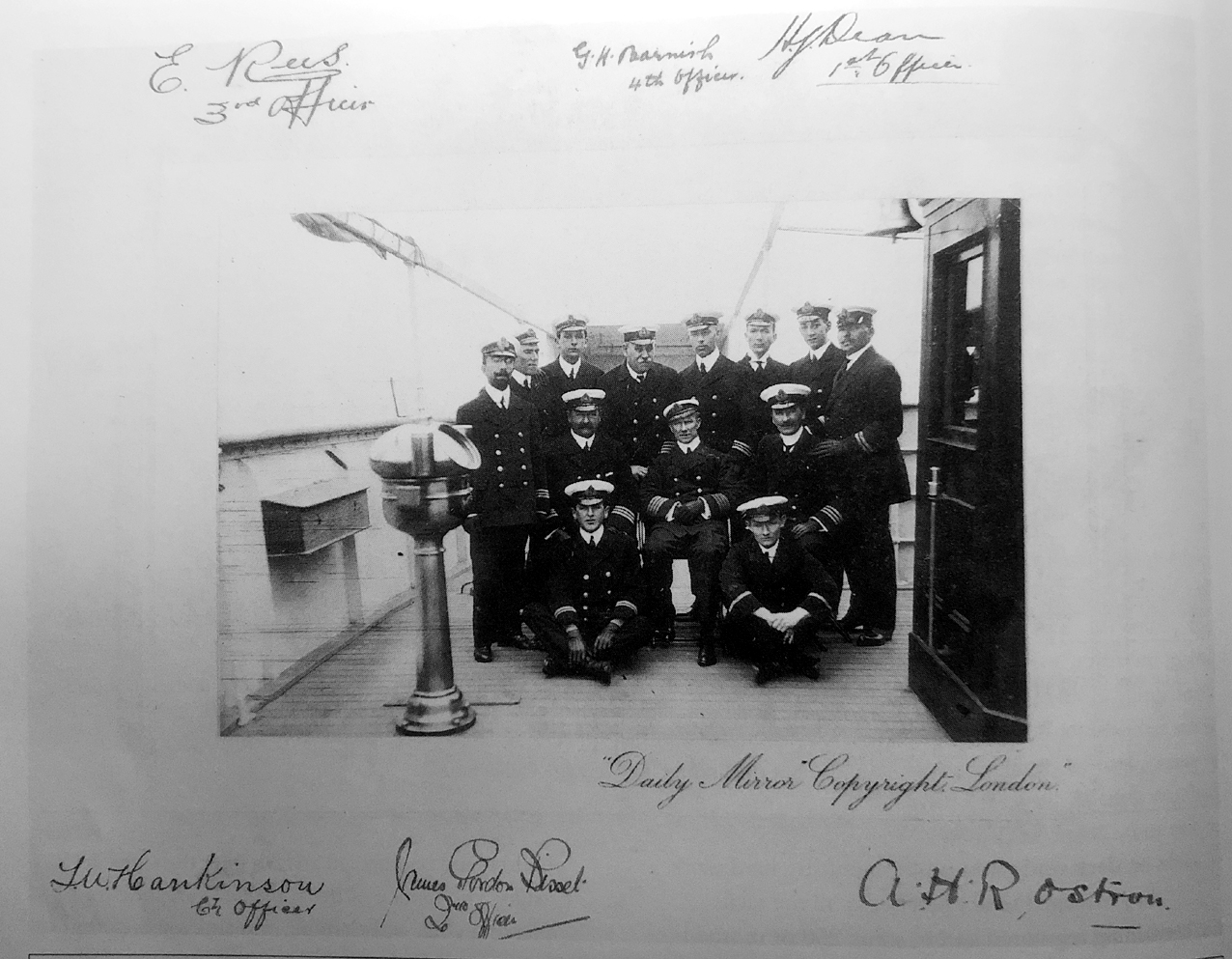
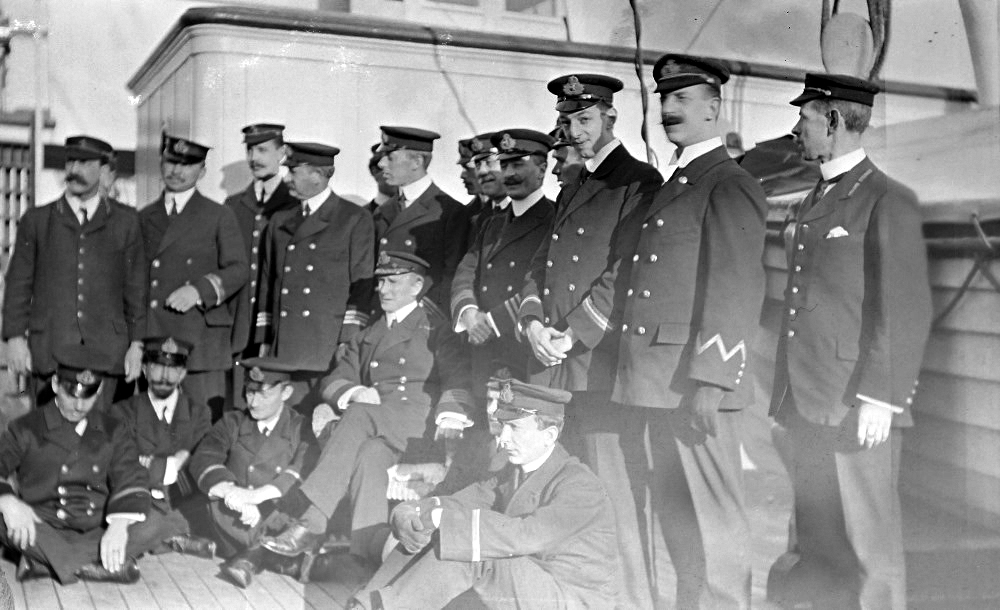
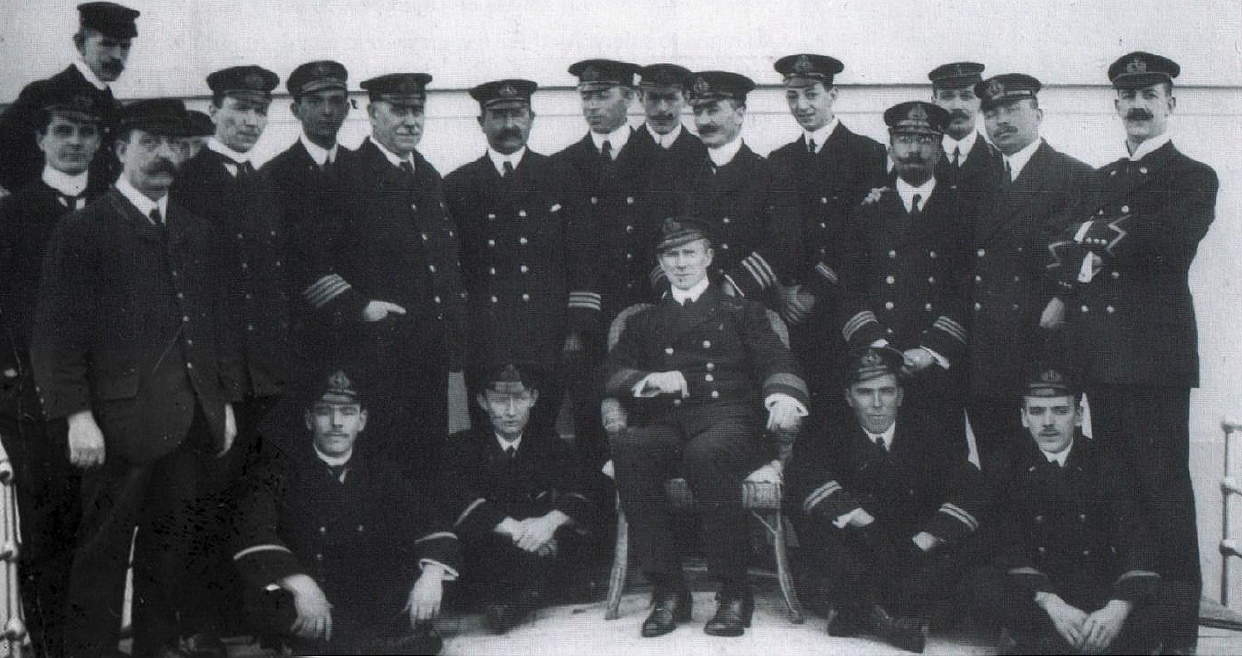
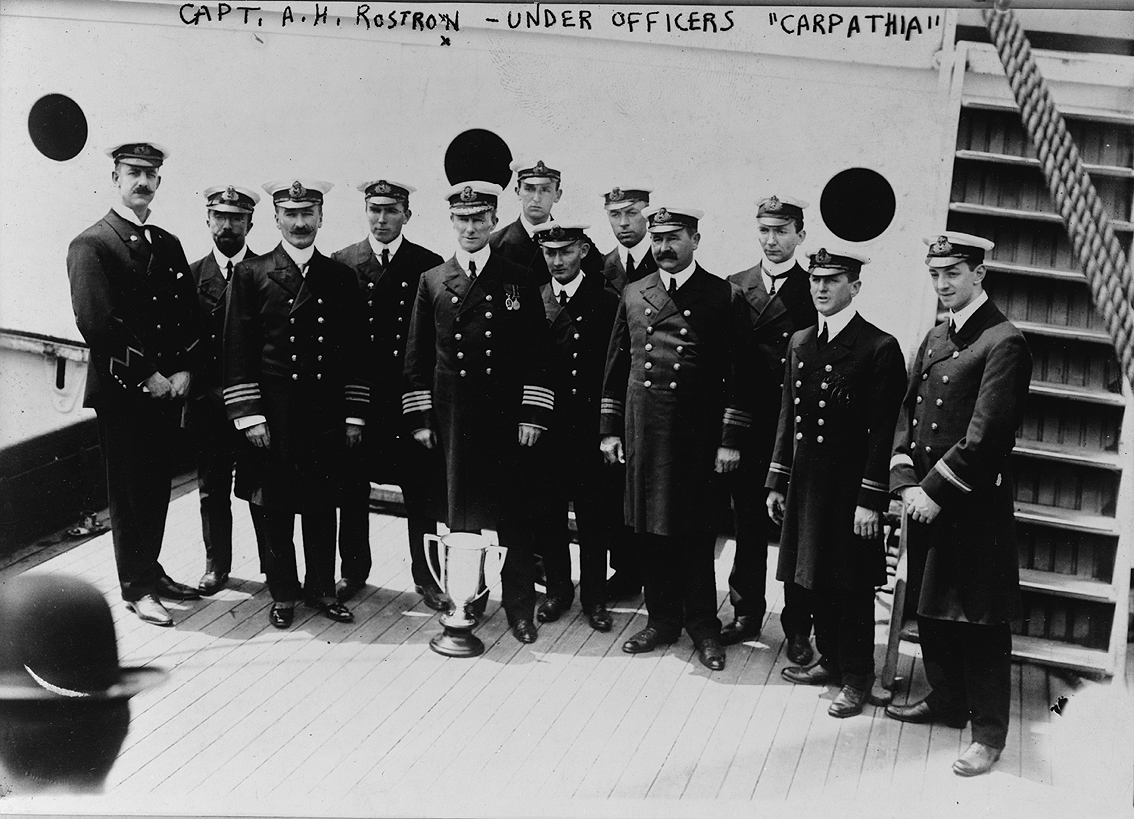
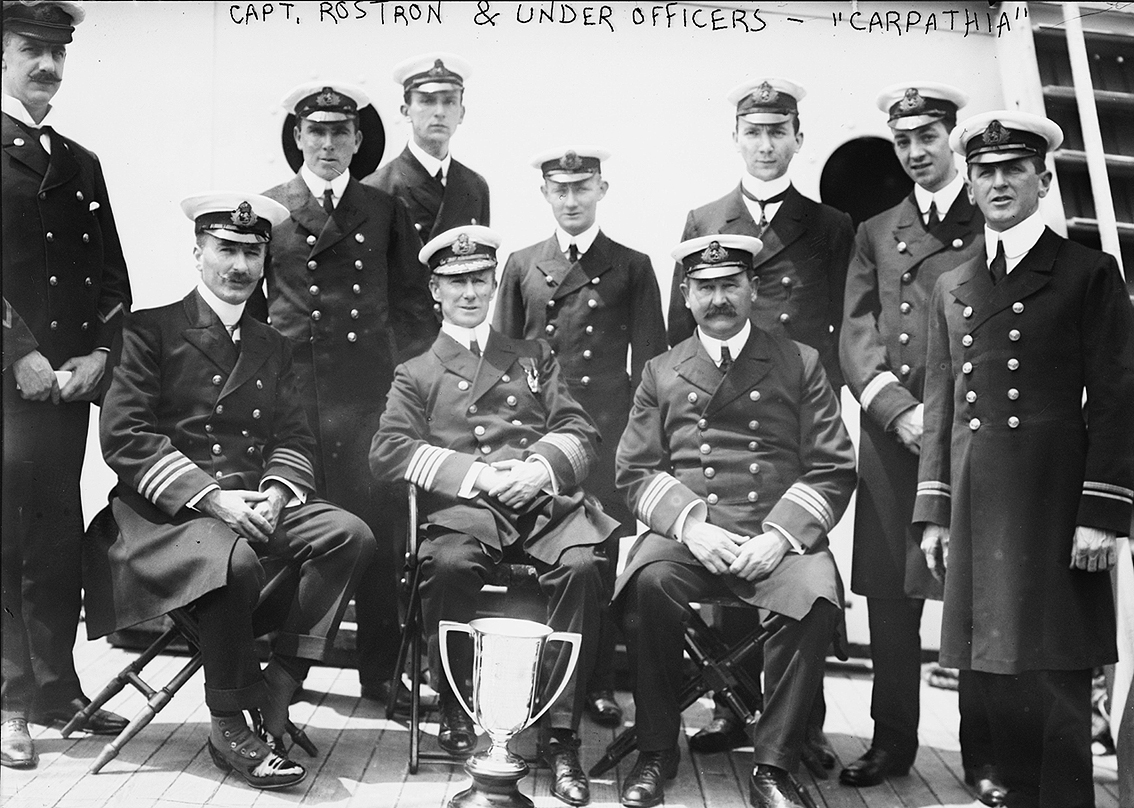
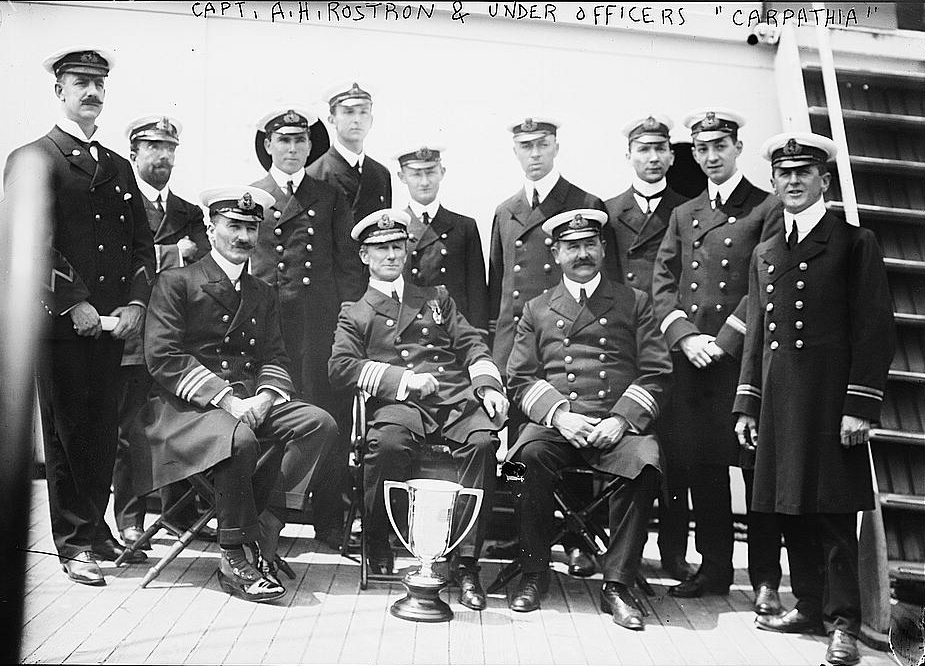
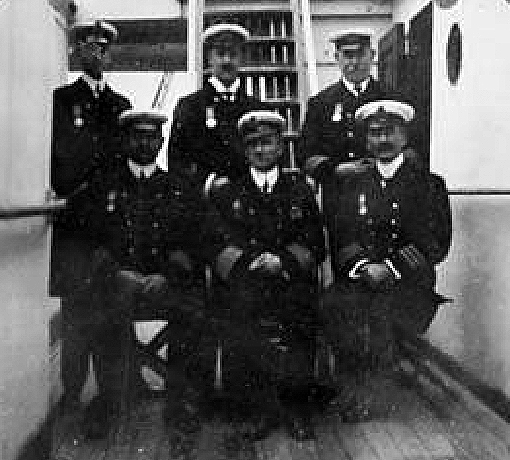
Hankinson also appears in several group photographs taken of the Rostron and his officers, proudly posing either seated or standing on the deck of the Carpathia.
Lightoller (middle) talks with Captain Arthur Rostron (right) on board R.M.S. Carpathia looked on by the ship's Chief Officer Hankinson
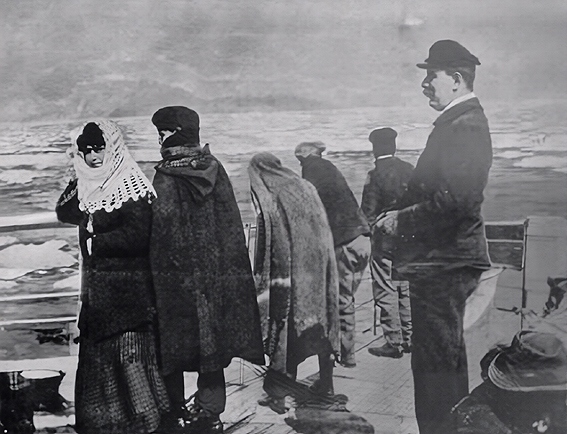
Unverified photograph of survivors aboard the R.M.S. Carpathia that was published in Switzerland in 1956 (L'Illustre, revue Hebdomadaire Suisse, 27 September 1956). The figure on the far right has a striking resemblance to Chief Officer Hankinson - except for his cap.
According to granddaughter Josephine Hearne "her Grandfather, and the other people she's met connected with the Titanic, didn't talk about what happened that April night in 1912. The people who survived the Titanic rescue didn’t want to talk about it, it was considered such an awful evening – so horrible. Then two years later the Great War came along, and the Titanic rather went into the background." (BBC "Memories of a Titanic hero" https://www.bbc.co.uk/herefordandworcester/content/articles/2006/04/11/titanic_carpathia_relative_feature.shtml
Autographed photograph of Carpathia's officers given to Fourth Officer Boxhall. Credit: Titanic Voices/Ford Collection. (Click image to enlarge)
On the evening of Thursday the 18th of April, the Carpathia arrived in New York under heavy rain and Rostron had the liner dock at the White Star Line Pier 59 to unload the 13 remaining lifeboats before then proceeding to the Cunard Pier 54 to disembark the 712 survivors. While aboard the Carpathia, survivor Margaret Brown had created the Titanic Survivors Committee, was elected its chair and raised substantial sums of money. Other than supporting those who had survived, she also arranged for the presentation of a silver loving cup to Captain Rostron, and gold, silver and bronze medals for the officers and crew on the 29th of May 1912:
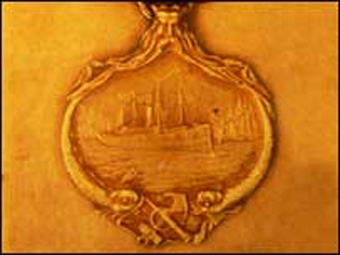
"The grateful survivors, through the Titanic Survivors Committee, commissioned a medal for the officers and crew of the Carpathia. Known as the Carpathia Commemorative M or simply the Carpathia Medal, the obverse featured a starboard view of the Carpathia sailing amongst icebergs with the lifeboats of R.M.S. Titanic in the water. The obverse is bordered with dolphins and surmounted by Neptune's head with a flowing beard. At the base of the obverse is a crossed anchor and staff. The reverse is inscribed, PRESENTED TO THE CAPTAIN OFFICERS AND CREW OF RMS CARPATHIA IN RECOGNITION OF GALLANT AND HEROIC SERVICE FROM THE SURVIVORS OF THE SS TITANIC APRIL 15TH 1912 DIEGES & CLUST NY. (maker's mark). Senior officers, including Captain Rostron, were given 14-karat yellow gold medals, junior officers received silver medals, and the crew received bronze medals. In total, 304 medals were awarded, 14 gold, 110 silver, and 180 bronze. Based on commentary, there may have been a small number, which were not awarded." (The Medal Hound, "RMS Carpathia Medals, http://themedalhound.com/carpathia/)
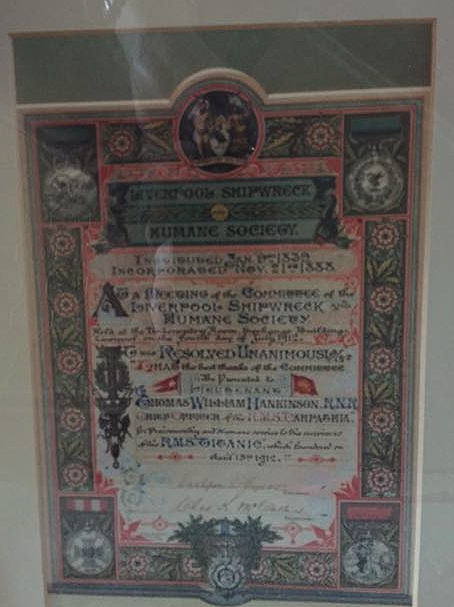
As the Carpathia's Chief Officer, Hankinson received a gold medal as described above, along with a silver medal from the Liverpool Shipwrecking Humane Society. Granddaughter Josephine Hearne described to the BBC in 2006:
"In the family we still have the medals that were awarded to my grandfather, and they are still in their original cases. I have the silver one from the Liverpool Shipwrecking[sic] Humane Society, and only eight of those were awarded. With that goes the citation that now hangs in my hall, and used to hang in my Grandfather’s hall when I was a child, so I’ve been familiar with it all my life."
The gold medal given to Chief Officer Hankinson (BBC/Josephine Hearne)
Hankinson's Liverpool Shipwreck Humane Society certificate (Credit: Neilan Symondson)
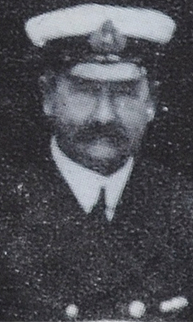
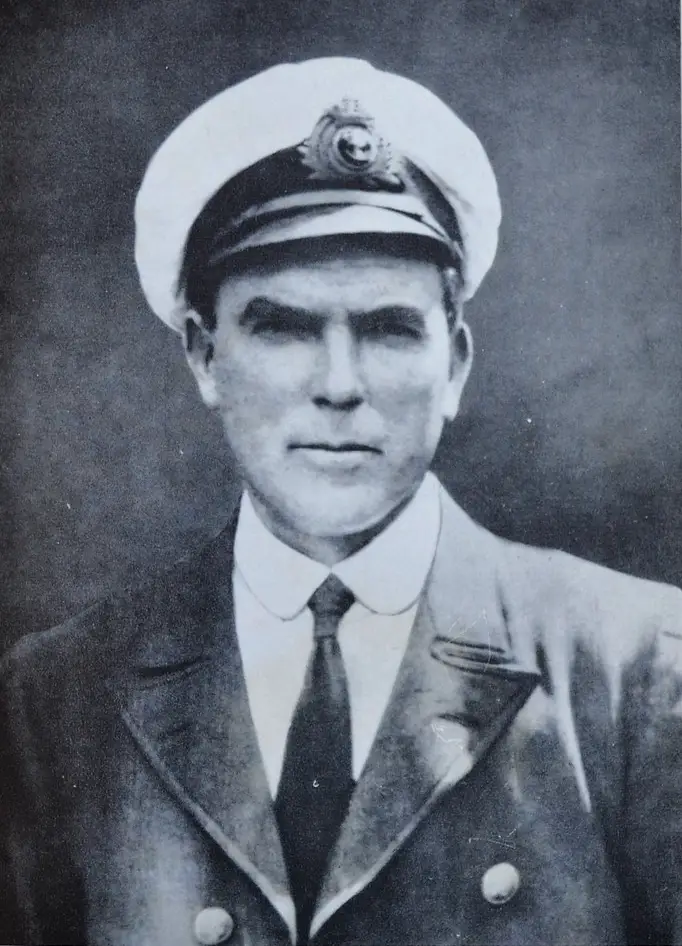
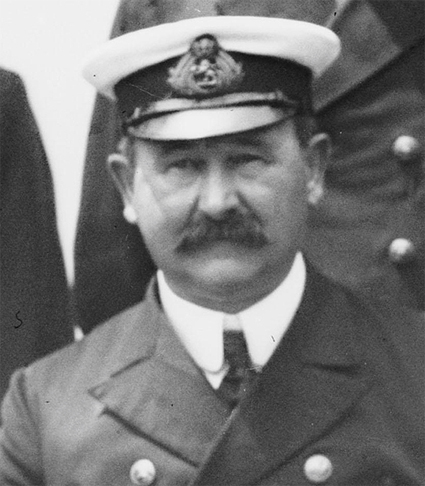
Chief Officer Thomas Hankinson photographed in 1912.
Group photographs
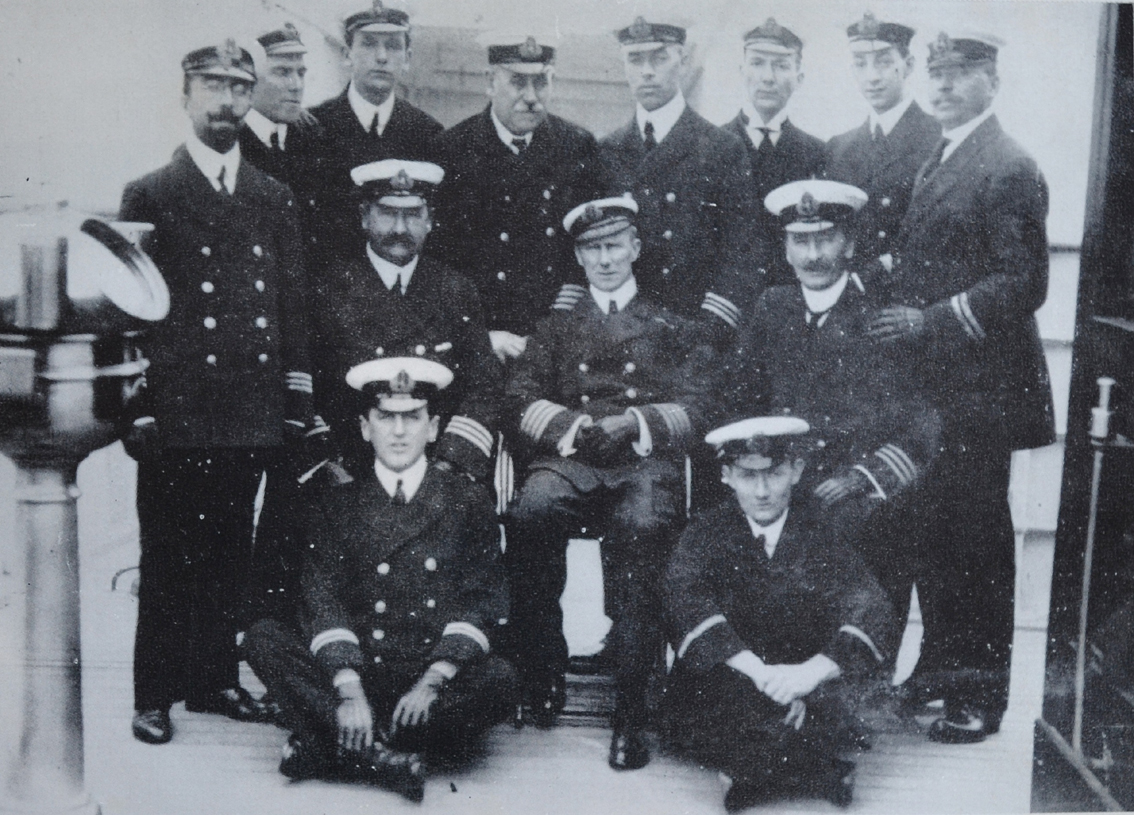
Photograph of the Carpathia's officers and crew assembled on the bridge, 1912. Back row: Dr. Vittorio Risicato, Second Officer James Bisset, Supernumerary Officer Gustav Rath, Chief Engineer Alexander Johnston, First Officer Horace Dean, Assistant Purser Percy Barnett, Purser E.F.G. Brown, Dr. Árpád Lengyel.
Center row: Chief Officer Hankinson, Captain A.H. Rostron, Dr Frank McGhee.
Front row: Third Officer Eric Rees, Fourth Officer Geoffrey Barnish. (Click image to enlarge)
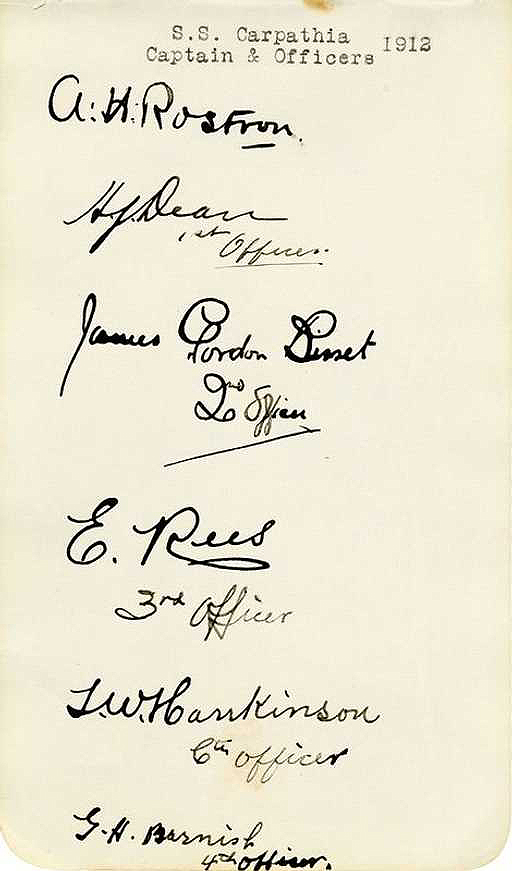
Autographs of the Carpathia's officers. From topL Captain Arthur Rostron, First Officer Dean, Second Officer Bisset, Third Officer Rees, Chief Officer Hankinson, Fourth Officer Barnish (Click image to enlarge)
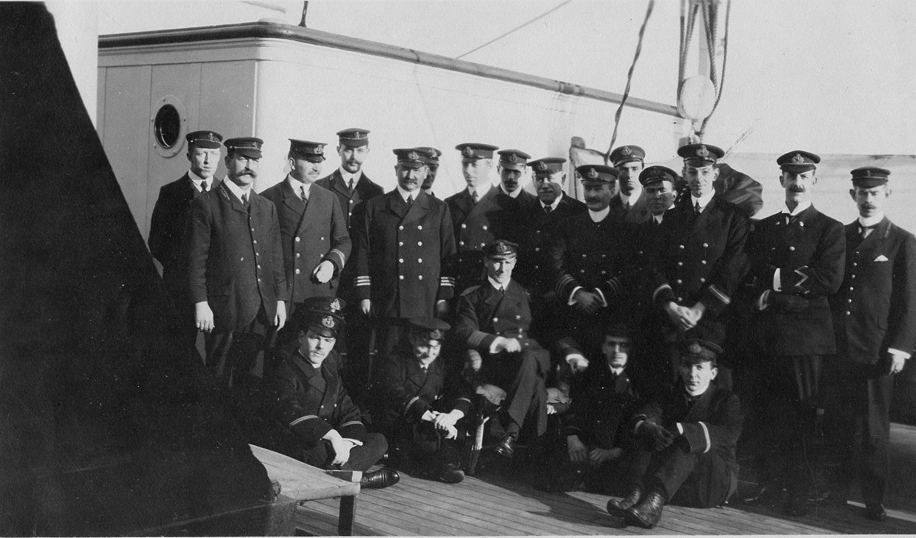
A photograph of the Carpathia's officers standing on the deck in 1912. Harkinson is standing 5th from the left. (Click image to enlarge)
Alternate photograph of the Carpathia's officers standing on the deck in 1912, looking away. Harkinson is standing on 6th from the left. Credit: Fenwick collection. (Click image to enlarge)
Same as above, but slightly different photograph of the Carpathia's officers standing on the deck in 1912, looking away. Harkinson is standing on 4th from the left. Credit: James and Mabel Fenwick/Henry Aldridge (Click image to enlarge)
Photograph of Carpathia's officers and crew assembled on the deck in 1912. Harkinson is standing 7th from the left. (Click image to enlarge)
A photograph of the Carpathia's officers standing on the well deck in 1912. Harkinson is standing 4th from the right. Note the white "topper" caps which places this as further after the event than the previous photographs in which they are without the topper (the white "topper" cap is worn during the transition between winter and summer). (Click image to enlarge)
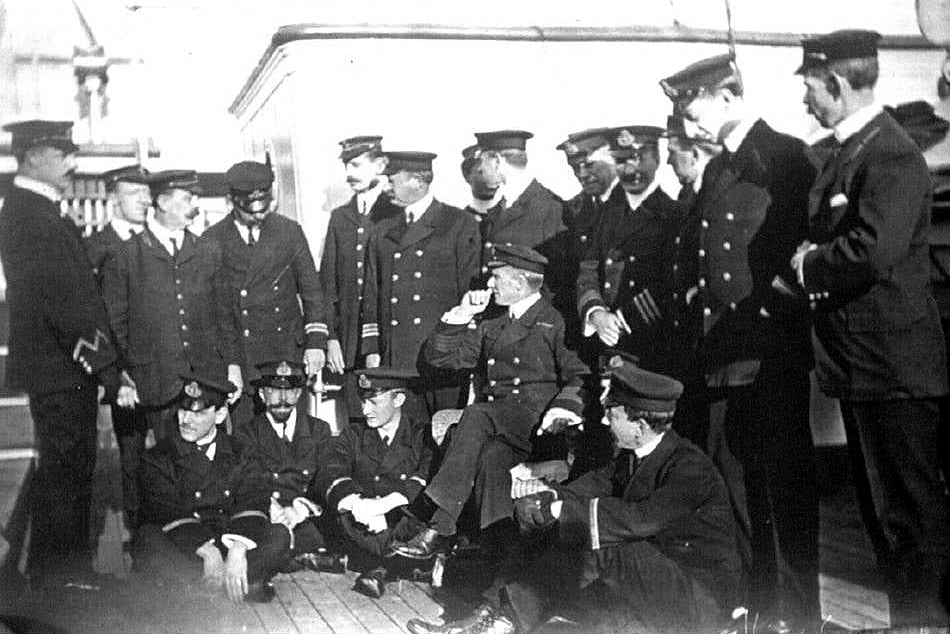
Alternate photograph of a smaller group of theCarpathia's officers assembled on the well deck in 1912. Harkinson is sitting on the right. (Click image to enlarge)
Alternate view of a smaller group of theCarpathia's officers assembled on the well deck in 1912 - looking to their left. Harkinson is sitting on the right. (Click image to enlarge)
A small group of Carpathia officers posing with Captain Arthur Rostron, with what appears to be medals on their uniforms. They are wearing white "topper" caps which indicates it is the transition between winter and summer. Hankinson (with three stripes on his sleeve) is seated on the far left. (Ogden library collection)
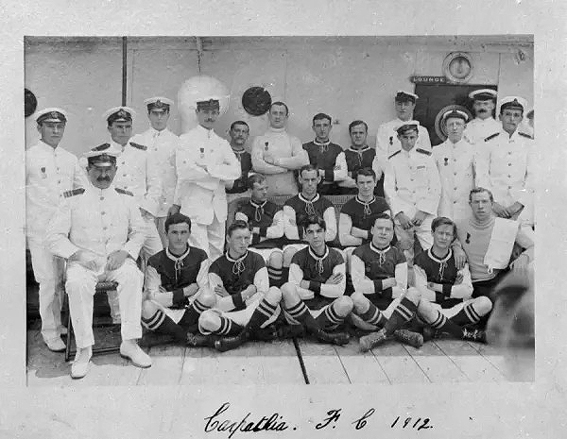
Members of the Carpathia football club, posing with the Carpathia officers, some of whom are wearing the medal awarded due to the Titanic rescue. Hankinson is seated - second from the left. (Mary Evans Picture Library/ONSLOW AUCTIONS LIMITED)
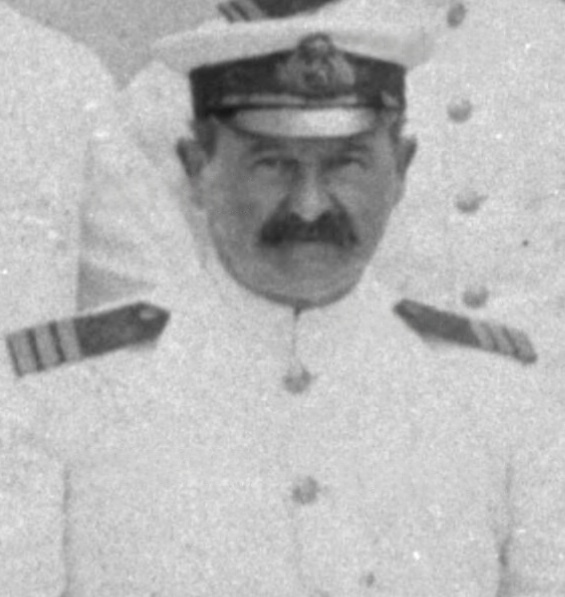
A close up of Hankinson posing with members of the Carpathia football club, some of whom are wearing the medal awarded due to the Titanic rescue, a;though Hankinson is not. They are wearing their summer whites which indicates this was during the summer of 1912. (Mary Evans Picture Library/ONSLOW AUCTIONS LIMITED)